Vector Applications notes (Precalculus)
Apply vectors to physics and navigation problems.
The big question
✈️ + 💨
Where does a plane go in the wind? Add the vectors!
Learn it, step by step
1. Plane and wind
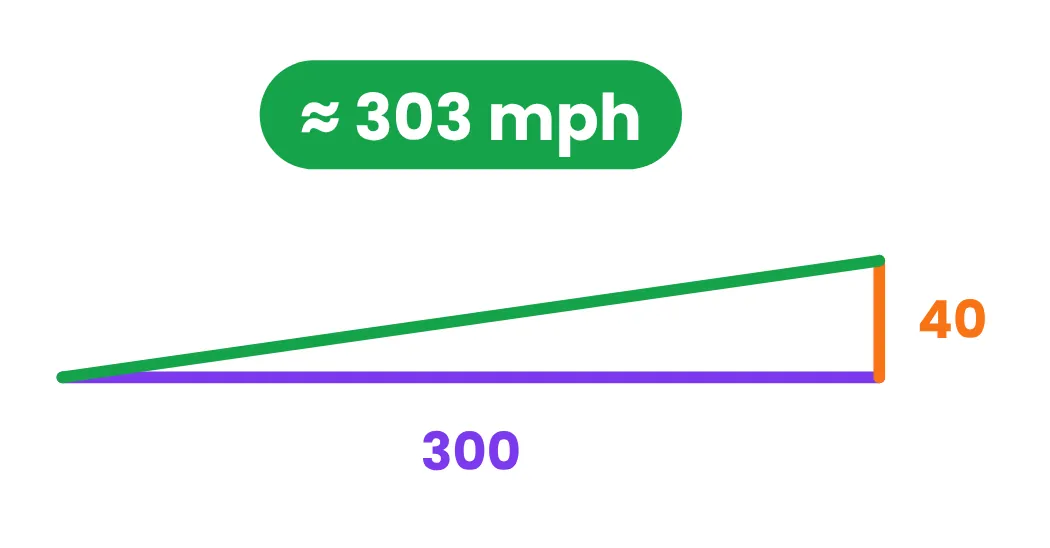
A plane flies east at 300 mph. A wind blows north at 40 mph.
Ground velocity: ⟨300, 40⟩. Speed √(300² + 40²) ≈ 303 mph.
≈ 303 mph
2. Direction
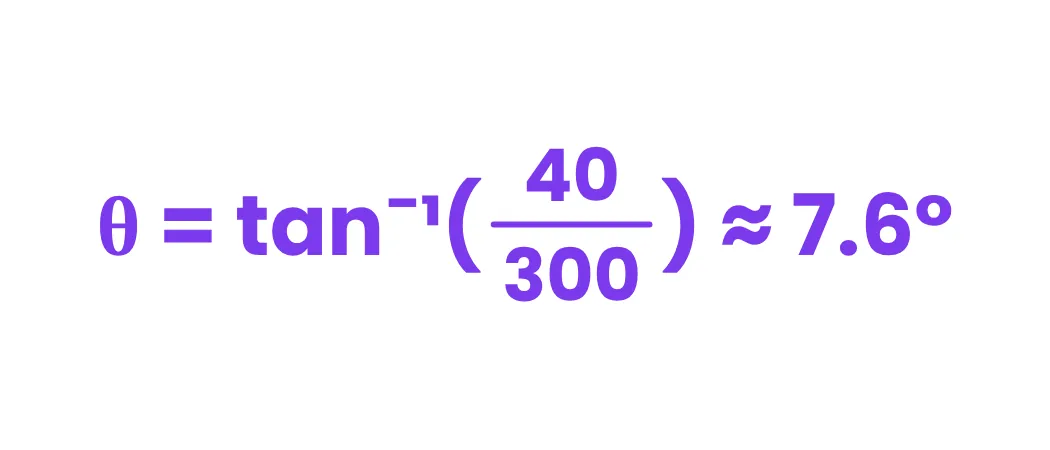
The angle north of east: tan⁻¹(40/300) ≈ 7.6 degrees.
θ = tan⁻¹(40/300) ≈ 7.6°
3. Forces
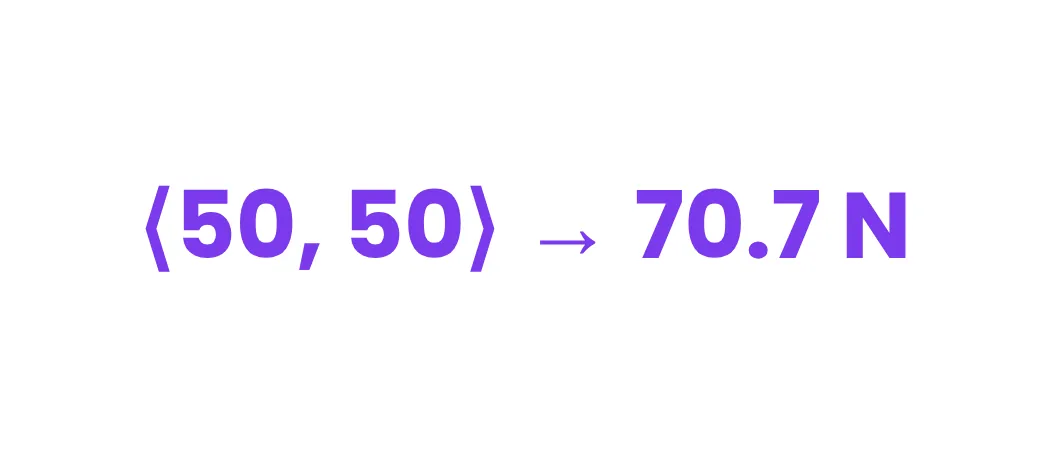
Two people pull a box with forces ⟨50, 0⟩ and ⟨0, 50⟩. Net force ⟨50, 50⟩, about 70.7 newtons.
⟨50, 50⟩ → 70.7 N
Watch out: Add vectors, not speeds
300 mph plus 40 mph wind at a right angle isn't 340.
Wrong: 300 + 40 = 340. Right: √(300² + 40²) ≈ 303.
Your turn
A boat goes ⟨6, 0⟩ and the current is ⟨0, −8⟩. What is the resulting speed?
⟨6, 0⟩ + ⟨0, −8⟩
Answer: 10. √(36 + 64) = 10!
Remember
Write each motion or force as a vector, add, then find magnitude and direction.
add → magnitude → angle
Watch the Vector Applications lesson and practice · Printable worksheet