Sinusoidal Modeling notes (Precalculus)
Model real-world periodic phenomena.
The big question
🎡
How can a sine wave model real life? Anything that repeats!
Learn it, step by step
1. A Ferris wheel
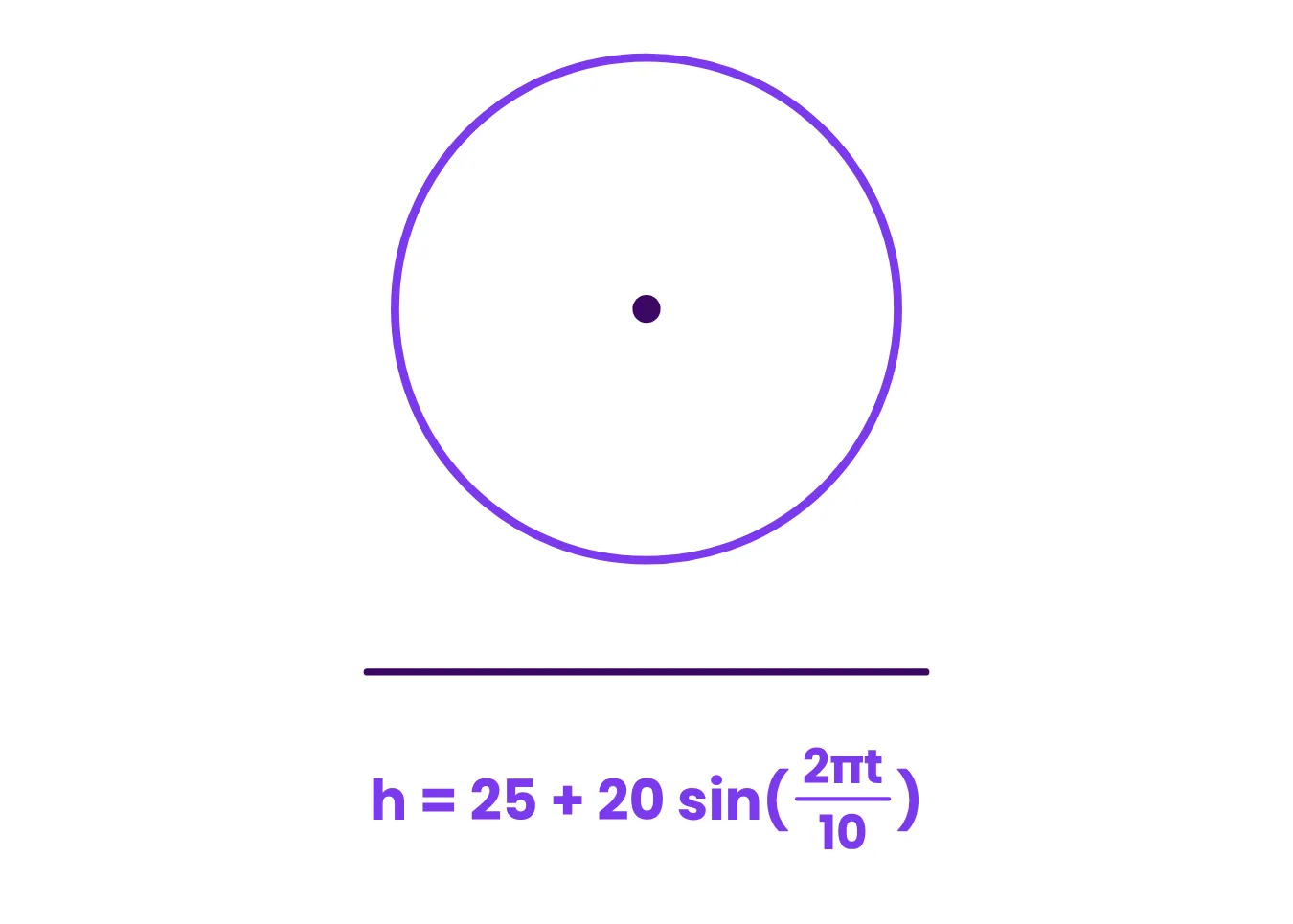
A Ferris wheel 40 m across, center 25 m high, one turn every 10 minutes.
Height h = 25 + 20 sin(2πt ÷ 10).
h = 25 + 20 sin(2πt/10)
2. Read the parts
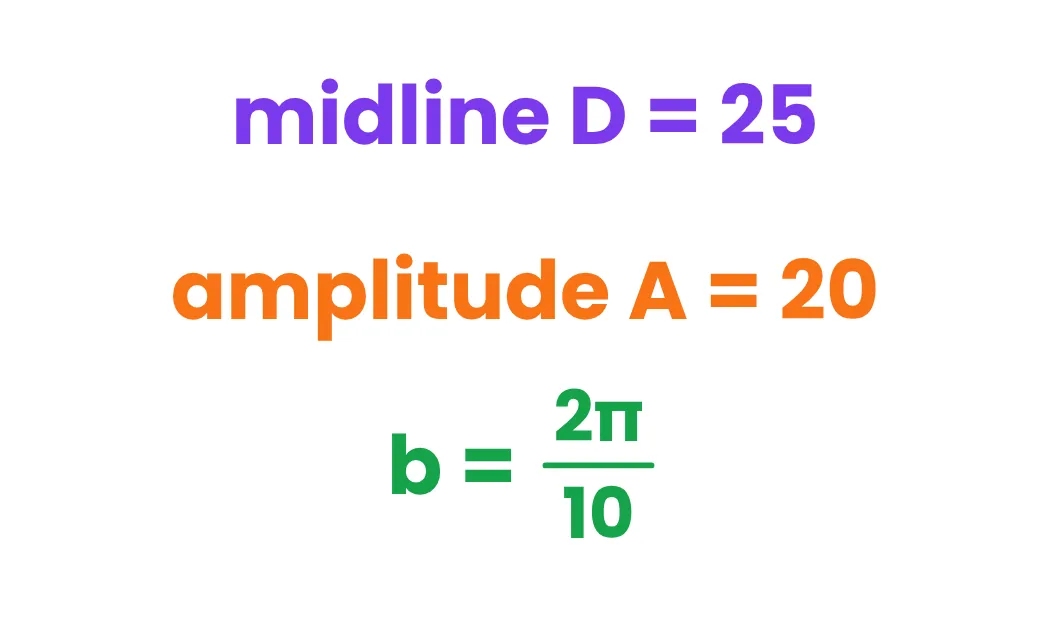
Midline: 25, the middle height. Amplitude: 20, the radius.
Period: 10 minutes, so b = 2π ÷ 10.
midline D = 25
amplitude A = 20
b = 2π / 10
3. Amplitude from high and low: step by step
An ocean tide varies from 3 feet to 15 feet. What is the amplitude?
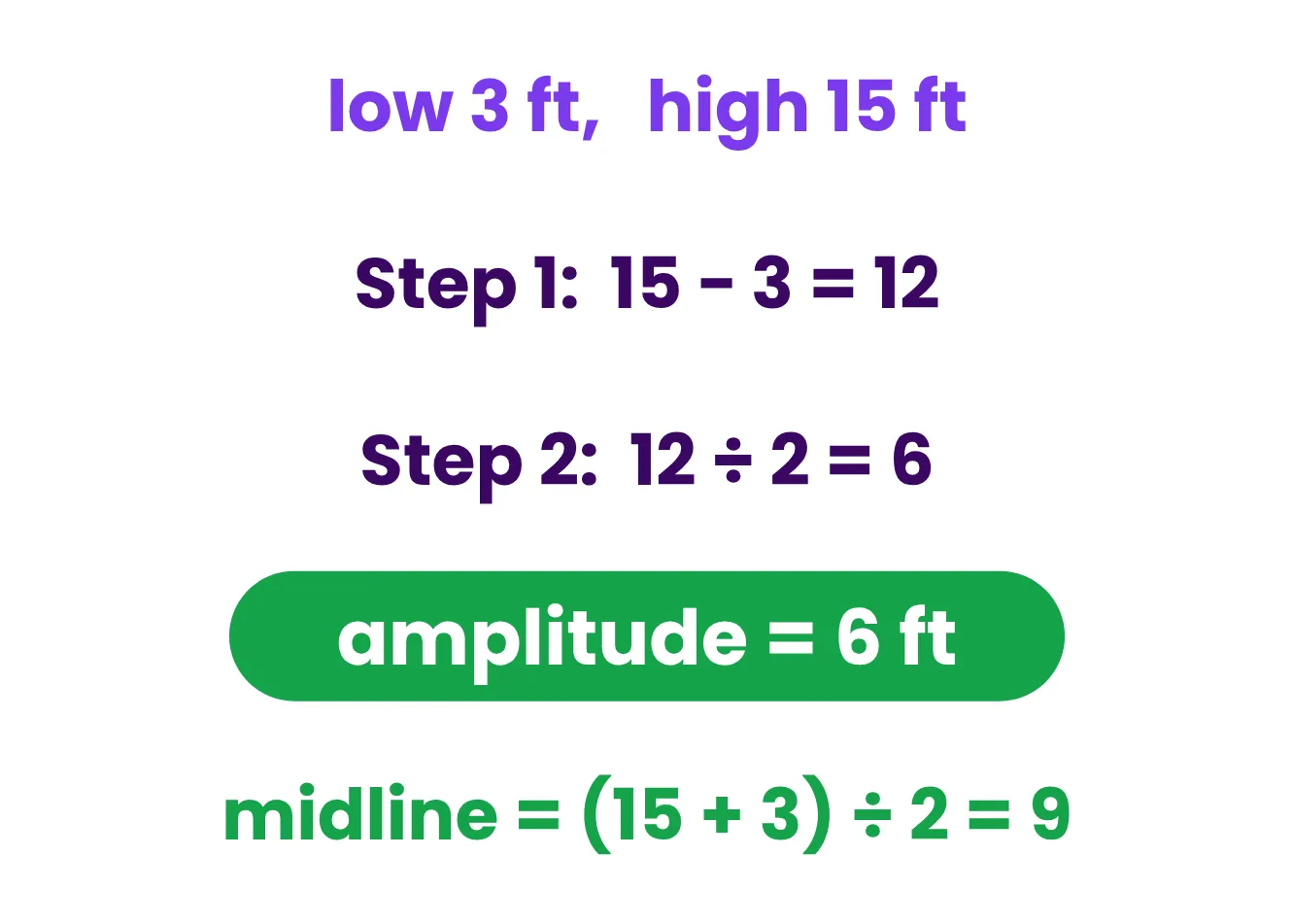
Step 1. Find the distance from low to high: 15 − 3 = 12.
Step 2. The amplitude is half of that: 12 ÷ 2 = 6 feet.
The midline is halfway between: 15 + 3 = 18, and half of 18 is 9.
low 3 ft, high 15 ft
Step 1: 15 − 3 = 12
Step 2: 12 ÷ 2 = 6
amplitude = 6 ft
midline = (15 + 3) ÷ 2 = 9
Watch out: Half the range
The amplitude is half of max minus min, not the whole range.
Wrong: A = 8 − 2 = 6. Right: A = (8 − 2)/2 = 3.
Your turn
Tides range from 2 m to 8 m. What are the midline and amplitude?
low 2 m, high 8 m
Answer: 5 and 3. Midline (2 + 8) ÷ 2 = 5. Amplitude (8 − 2) ÷ 2 = 3!
Remember
y = A sin(bt) + D: amplitude A, midline D, period 2π/b.
y = A sin(bt) + D
Watch the Sinusoidal Modeling lesson and practice · Printable worksheet