Geometric Series notes (Precalculus)
Find sums of finite and infinite geometric series.
The big question
1 + ½ + ¼ + …
Can an endless sum have a total? Sometimes!
Learn it, step by step
1. Finite sum
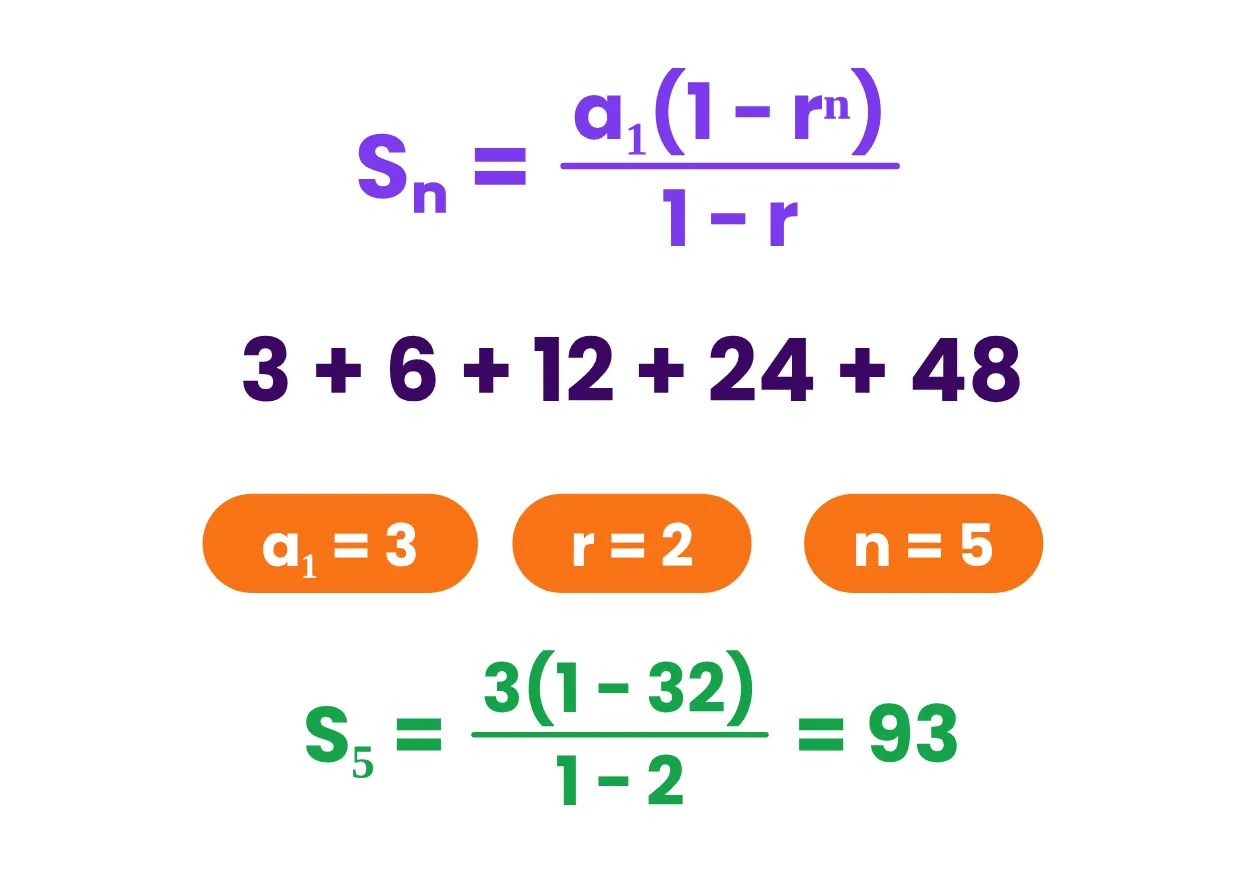
Sₙ = a₁(1 − rⁿ) ÷ (1 − r).
3 + 6 + 12 + 24 + 48: a₁ = 3, r = 2, n = 5. S = 3(1 − 32)/(1 − 2) = 93.
Sₙ = a₁(1 − rⁿ) / (1 − r)
3 + 6 + 12 + 24 + 48
a₁ = 3
r = 2
n = 5
S₅ = 3(1 − 32) / (1 − 2) = 93
2. Infinite sum
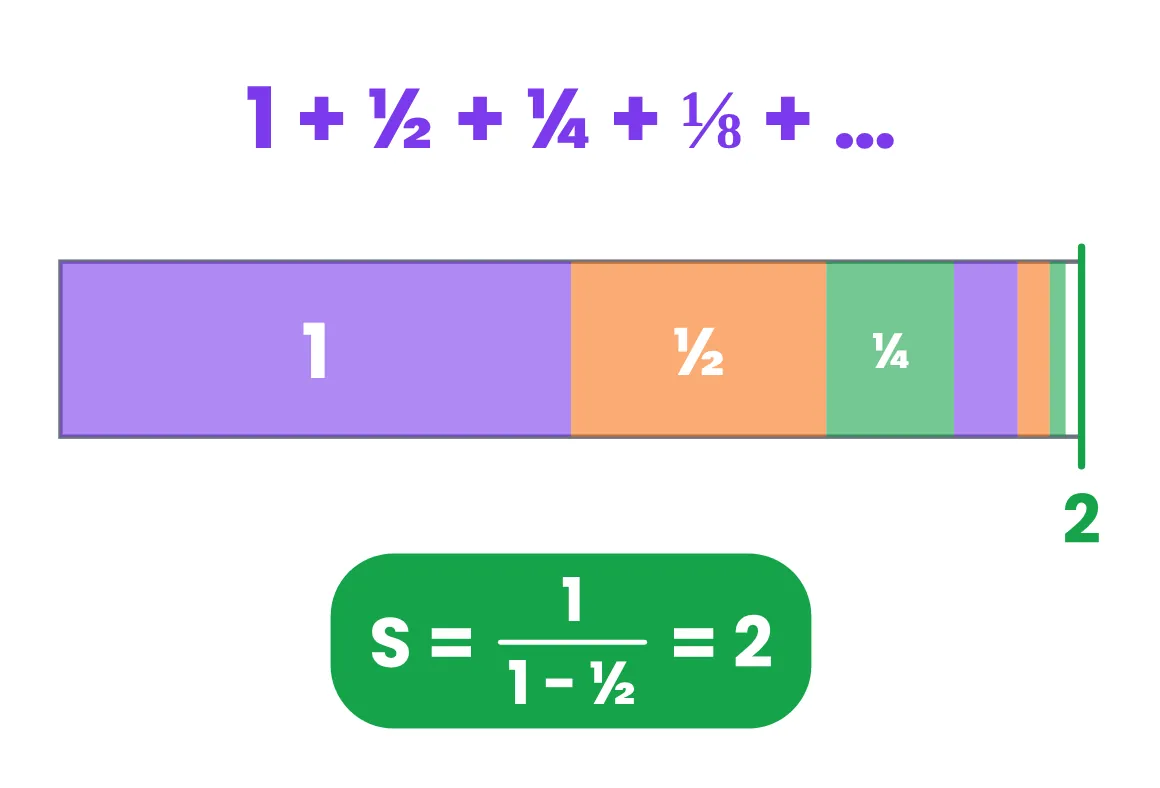
If r is between −1 and 1, the terms shrink, and the sum approaches a₁ ÷ (1 − r).
1 + ½ + ¼ + … = 1 ÷ ½ = 2.
1 + ½ + ¼ + ⅛ + …
S = 1 / (1 − ½) = 2
3. When it diverges
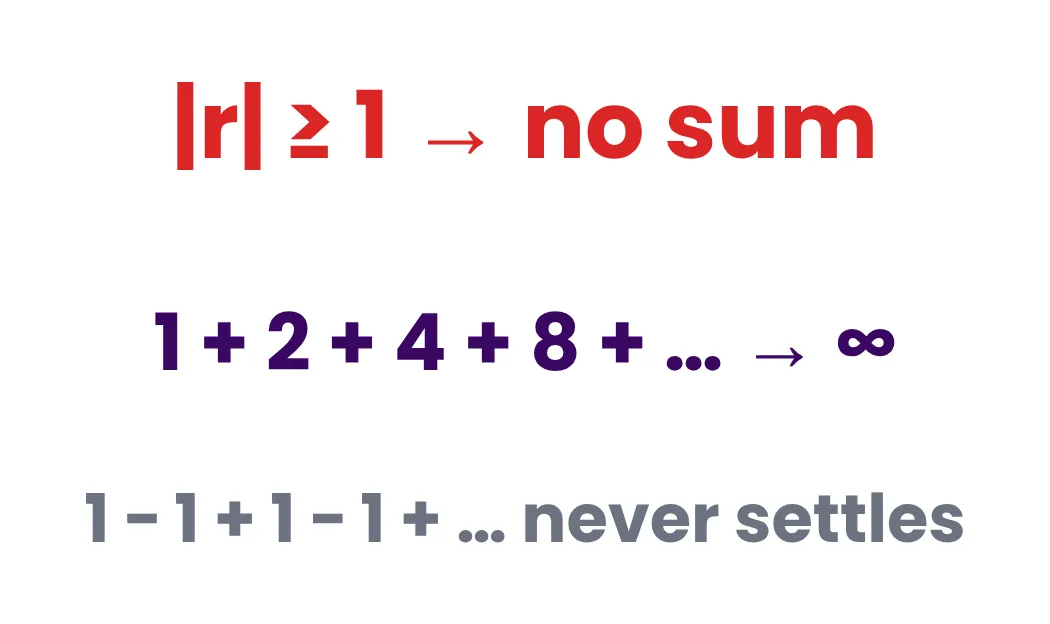
If |r| is 1 or more, the terms never shrink.
1 + 2 + 4 + … grows forever. 1 − 1 + 1 − 1 + … never settles.
|r| ≥ 1 → no sum
1 + 2 + 4 + 8 + … → ∞
1 − 1 + 1 − 1 + … never settles
Watch out: Check r first
The infinite formula only works when |r| < 1.
Wrong: r = 2: S = a/(1 − 2). Right: r = 2: no sum.
Your turn
Find 6 + 2 + 2/3 + … forever.
6 + 2 + 2/3 + …
Answer: S = 9. 6 ÷ (1 − ⅓) = 6 ÷ ⅔ = 9!
Remember
Finite: a₁(1 − rⁿ)/(1 − r). Infinite, |r| < 1: a₁/(1 − r).
Finite
Sₙ = a₁(1 − rⁿ) / (1 − r)
Infinite, when |r| < 1
S∞ = a₁ / (1 − r)
Watch the Geometric Series lesson and practice · Printable worksheet