Continuity notes (Precalculus)
Determine if functions are continuous.
The big question
✏️
Can you draw it without lifting your pencil? Then it's continuous!
Learn it, step by step
1. Three kinds of breaks
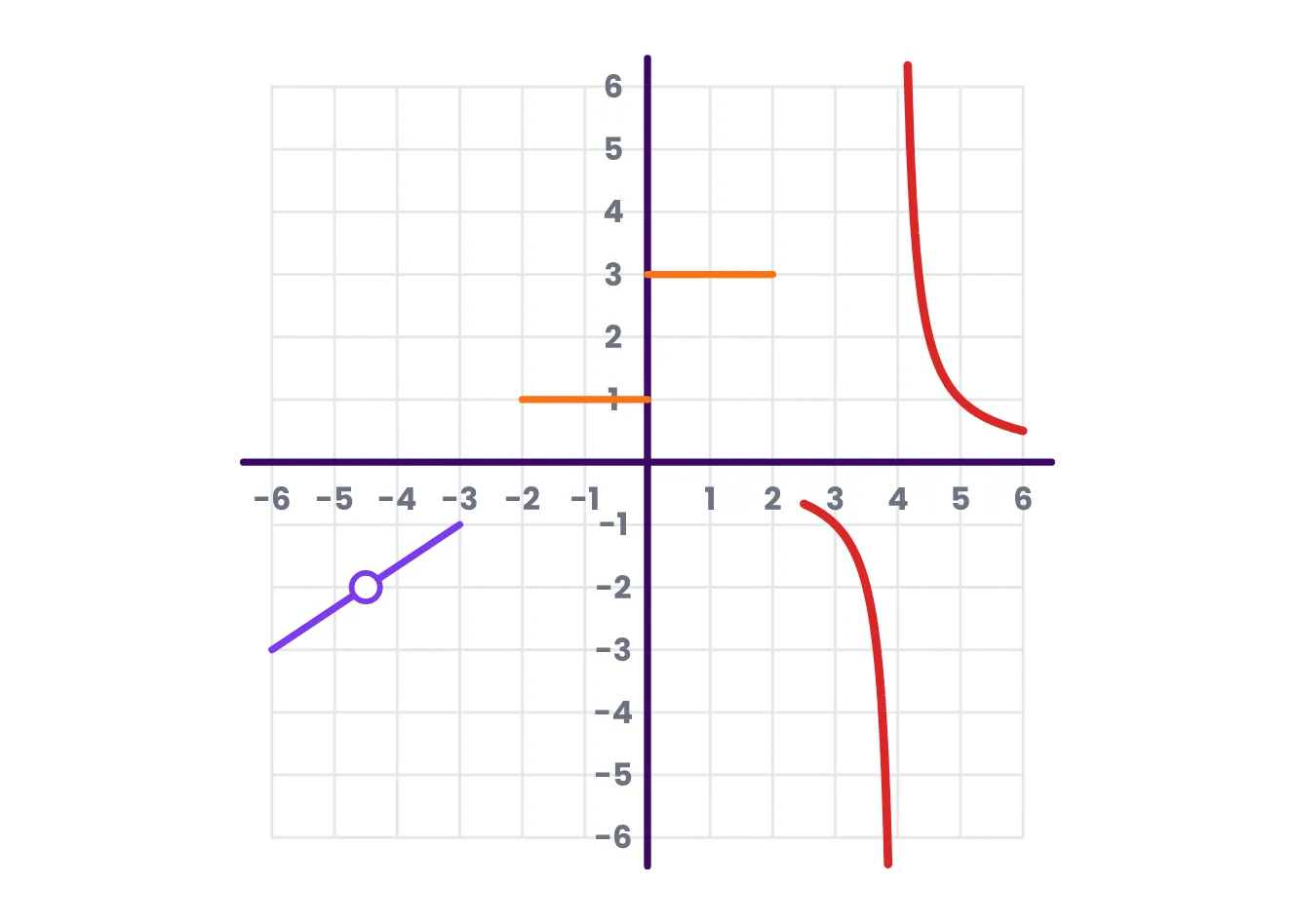
A hole: one point missing. A jump: the graph leaps. An asymptote: it shoots off.
2. The definition
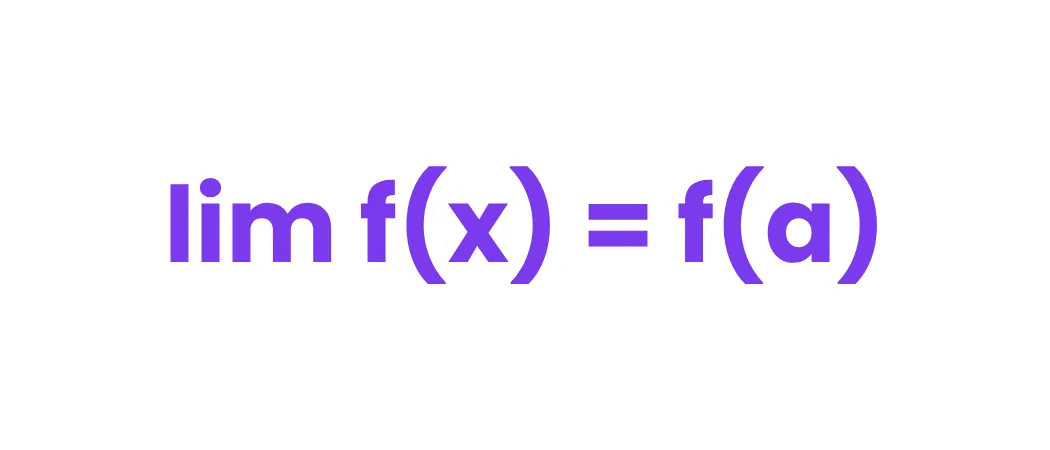
f is continuous at a if f(a) exists, the limit exists, and they're equal.
lim f(x) = f(a)
3. Find k: step by step
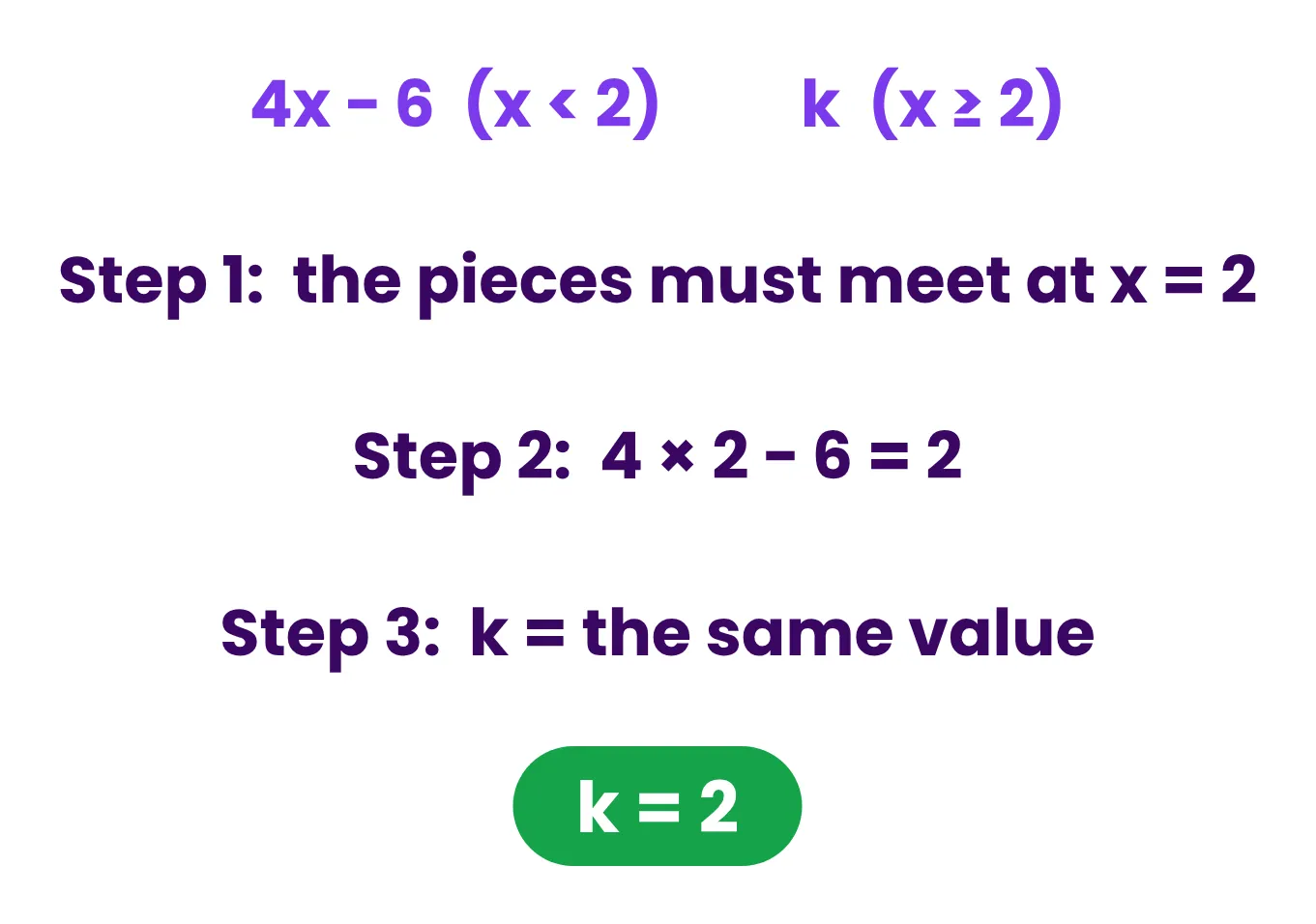
f(x) = 4x − 6 when x is less than 2, and f(x) = k when x is 2 or more. Which k makes f continuous?
Step 1. The two pieces must meet at x = 2.
Step 2. Put x = 2 into the first piece: 4 × 2 − 6 = 2.
Step 3. The second piece must give the same value, so k = 2.
4x − 6 (x < 2) k (x ≥ 2)
Step 1: the pieces must meet at x = 2
Step 2: 4 × 2 − 6 = 2
Step 3: k = the same value
k = 2
Watch out: All three conditions
A limit existing isn't enough. f(a) must exist and match it.
Wrong: limit exists → continuous. Right: limit = f(a) → continuous.
Your turn
Is f(x) = (x² − 1)/(x − 1) continuous at x = 1?
(x² − 1)/(x − 1)
Answer: no: a hole. No! f(1) is undefined, so there's a hole.
Remember
Continuous means no holes, jumps or asymptotes: the limit equals the value.
lim = value
Watch the Continuity lesson and practice · Printable worksheet