Complex Numbers in Polar Form notes (Precalculus)
Convert complex numbers to polar form.
The big question
r(cos θ + i sin θ)
Can complex numbers have a direction? Yes, on the complex plane!
Learn it, step by step
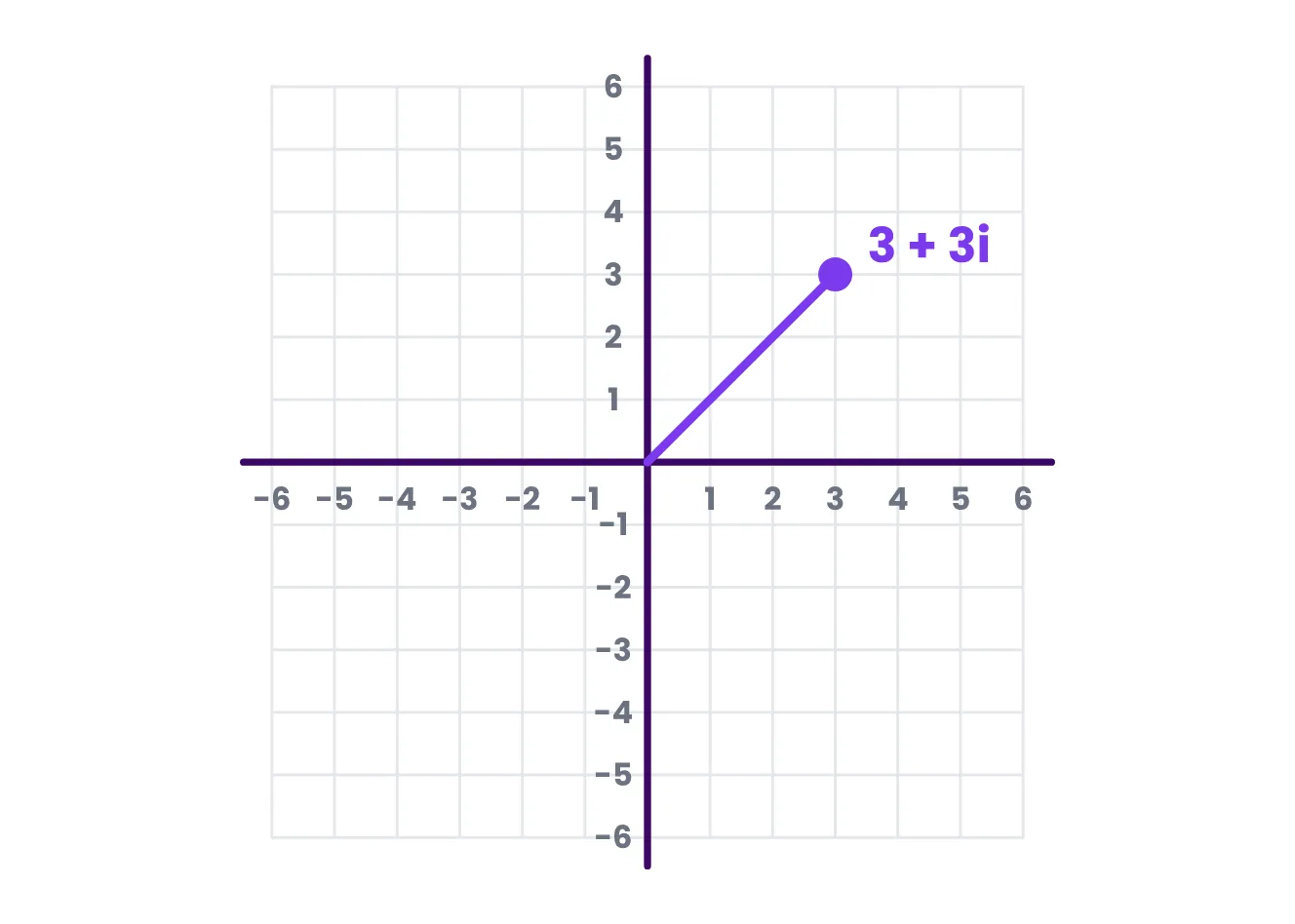
1. The complex plane
Plot a + bi like the point (a, b): real across, imaginary up.
1 + i is at distance √2, angle 45 degrees.
3 + 3i
2. Polar form
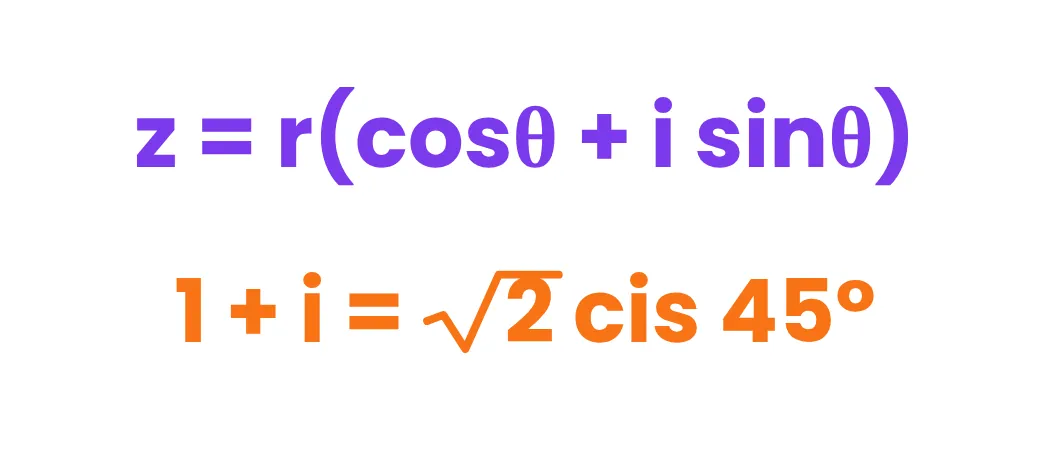
z = r(cos θ + i sin θ), where r = √(a² + b²) and θ is the angle.
1 + i = √2(cos 45° + i sin 45°).
z = r(cosθ + i sinθ)
1 + i = √2 cis 45°
3. Multiplying is easy
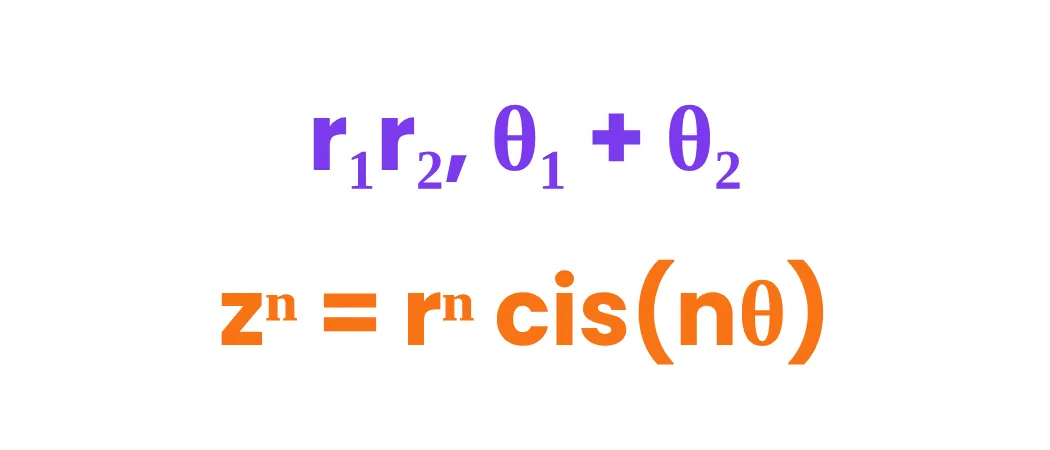
Multiply the r values and add the angles.
De Moivre: zⁿ = rⁿ(cos nθ + i sin nθ).
r₁r₂, θ₁ + θ₂
zⁿ = rⁿ cis(nθ)
Watch out: Add the angles
When multiplying, add angles. Don't multiply them.
Wrong: θ₁ · θ₂. Right: θ₁ + θ₂.
Your turn
Find (1 + i)² using polar form.
(√2 cis 45°)²
Answer: 2i. r² = 2 and 2θ = 90°: 2(cos 90 + i sin 90) = 2i!
Remember
Polar form: r(cos θ + i sin θ). Multiply r, add θ.
r cis θ
Watch the Complex Numbers in Polar Form lesson and practice · Printable worksheet