Fundamental Theorem of Algebra notes (Algebra 2)
Understand relationship between degree and roots.
The big question
degree n → n roots
How many roots can a polynomial have? Exactly as many as its degree!
Learn it, step by step
1. The theorem
A polynomial of degree n has exactly n roots, counting repeats and complex roots.
A cubic has 3. A quartic has 4.
degree n → n roots
x³: 3 x⁴: 4

2. Repeated roots
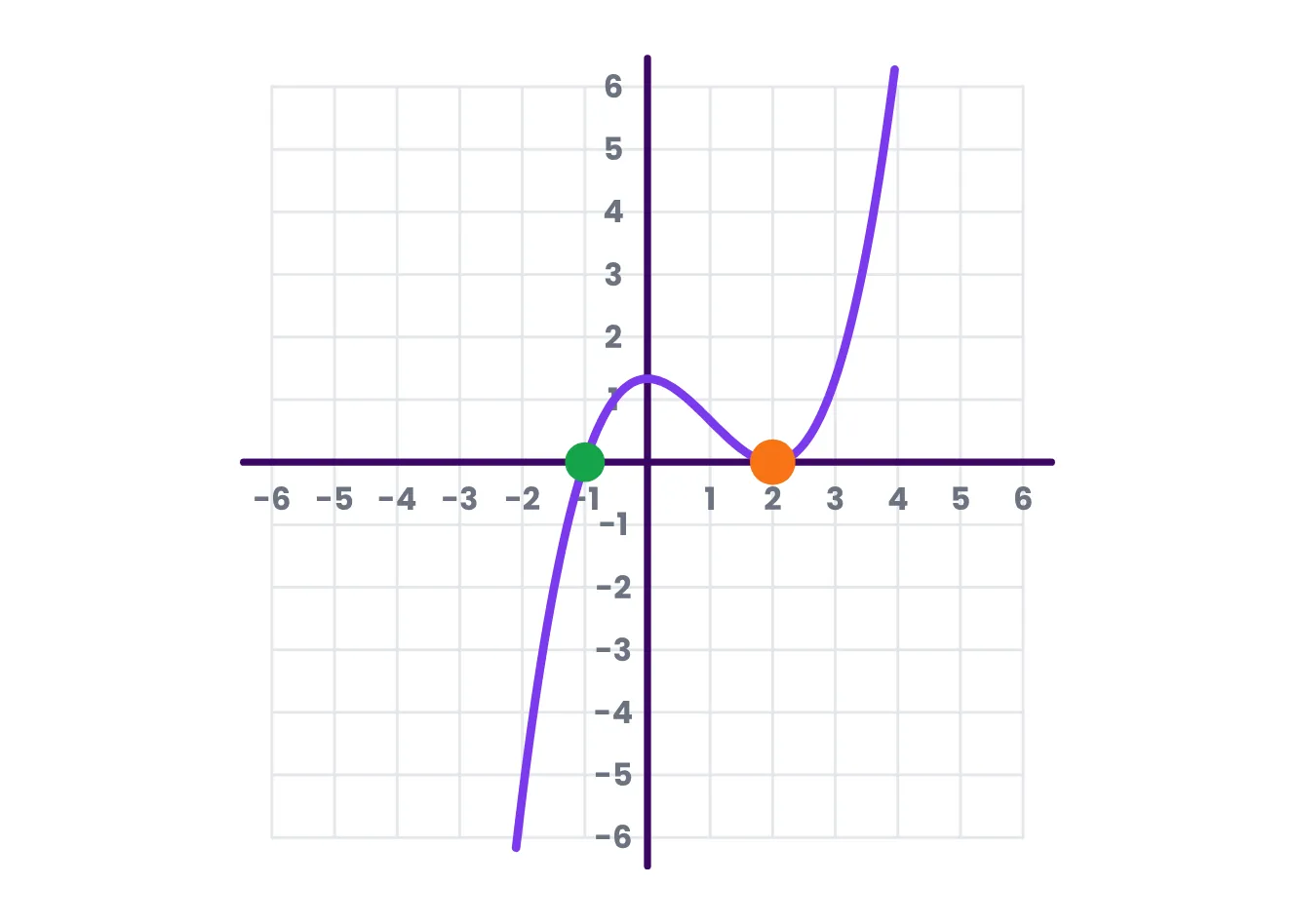
(x − 2)²(x + 1) is degree 3. Roots: 2, 2 and −1. The 2 counts twice.
The graph touches the axis at a double root and bounces.
3. Complex pairs
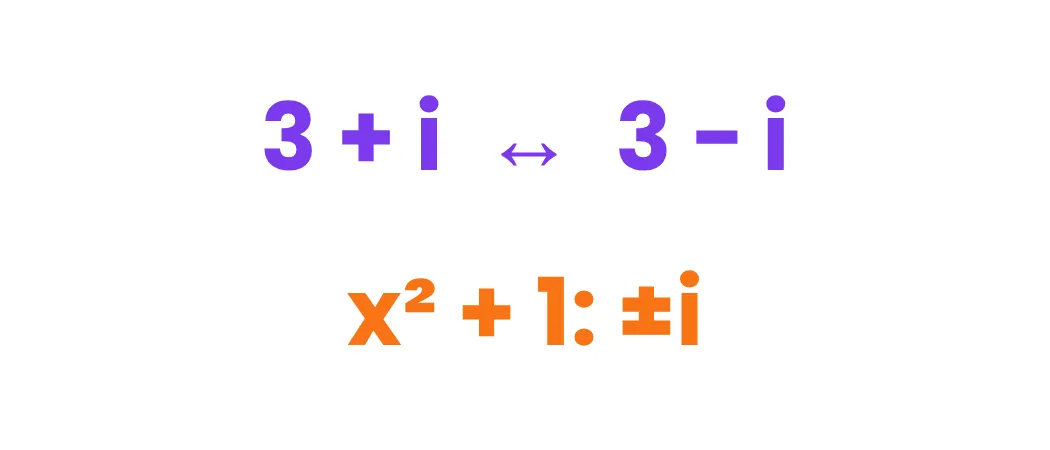
Complex roots come in pairs: if 3 + i is a root, so is 3 − i.
x² + 1 has no real roots, but two complex ones: i and −i.
3 + i ↔ 3 − i
x² + 1: ±i
Watch out: Count the repeats
A double root counts as two roots, not one.
Wrong: (x − 2)²: 1 root. Right: (x − 2)²: 2 roots.
Your turn
A degree 5 polynomial has 3 real roots. How many complex roots?
degree 5, 3 real
Answer: 2 complex. 5 − 3 = 2 complex roots, a conjugate pair!
Remember
Degree n: exactly n complex roots.
Repeats count, and complex roots come in conjugate pairs.
n roots
Watch the Fundamental Theorem of Algebra lesson and practice · Printable worksheet