Find Polynomial Roots notes (Algebra 2)
Find zeros using rational root theorem.
The big question
f(x) = 0
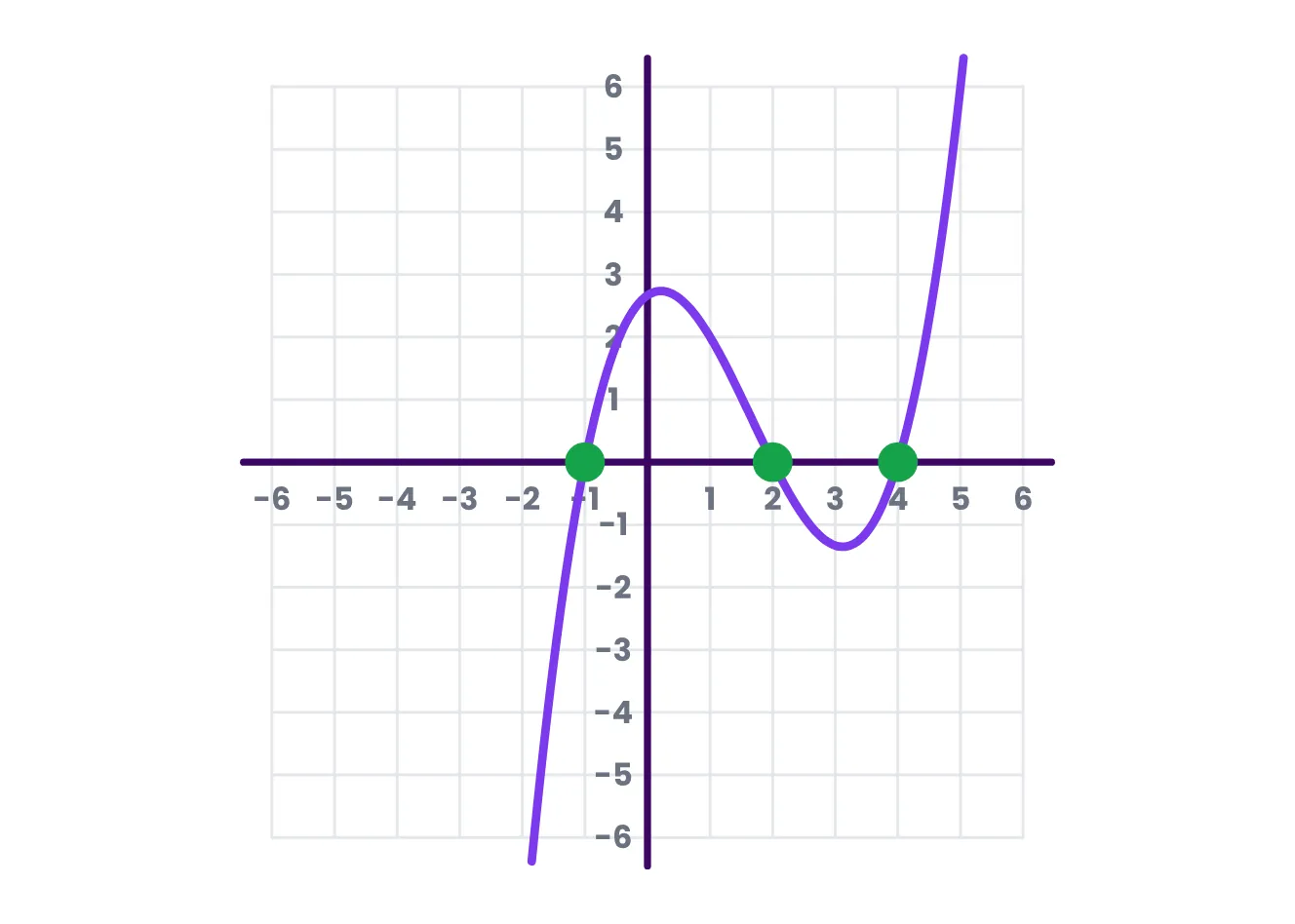
Where does a polynomial cross the x-axis? At its roots!
Learn it, step by step
1. Roots and factors
If (x − 3) is a factor, then 3 is a root: f(3) = 0.
f(x) = (x + 1)(x − 2)(x − 4) has roots −1, 2 and 4.
2. Rational root theorem
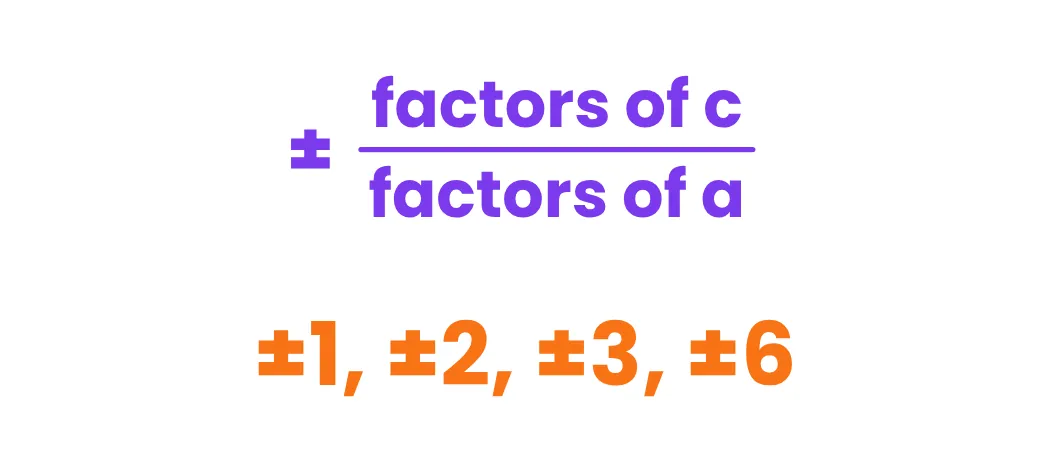
Possible rational roots are factors of the constant over factors of the leading coefficient.
For x³ − 6x² + 11x − 6: try ±1, ±2, ±3, ±6.
± (factors of c) / (factors of a)
±1, ±2, ±3, ±6
3. Test and divide
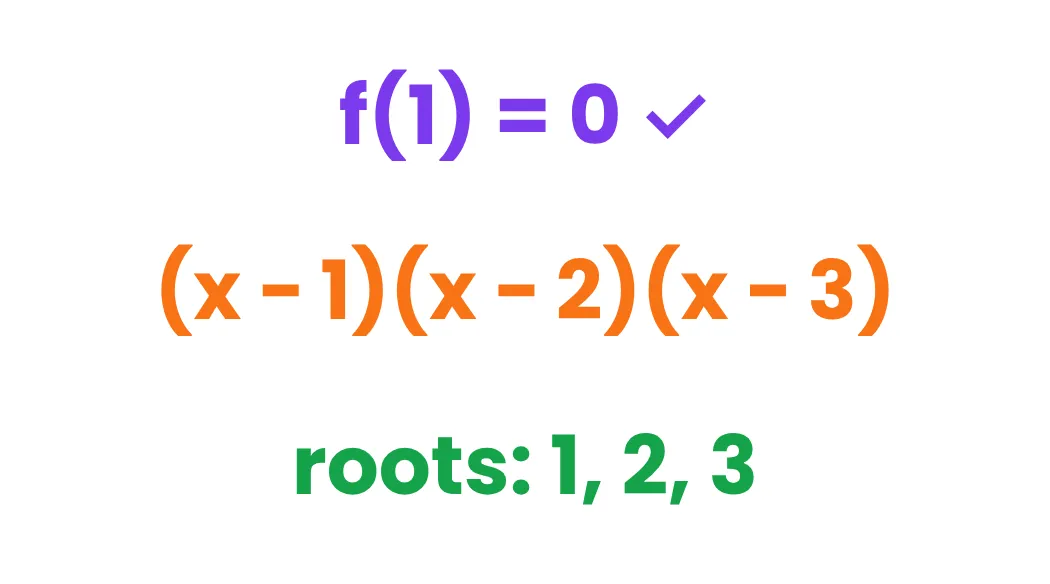
f(1) = 1 − 6 + 11 − 6 = 0. So 1 is a root.
Divide out x − 1: x² − 5x + 6 = (x − 2)(x − 3). Roots 1, 2, 3.
f(1) = 0 ✓
(x − 1)(x − 2)(x − 3)
roots: 1, 2, 3
Watch out: Opposite signs
The factor x + 2 gives the root −2, not 2.
Wrong: (x + 2) → root 2. Right: (x + 2) → root −2.
Your turn
What are the roots of f(x) = x(x − 5)(x + 2)?
x(x − 5)(x + 2)
Answer: 0, 5, −2. Set each factor to zero: 0, 5 and −2!
Remember
Each factor x − r gives a root r.
List possible rational roots, test them, then divide.
(x − r) ↔ root r
Watch the Find Polynomial Roots lesson and practice · Printable worksheet