Compound Interest notes (Algebra 2)
Calculate compound interest and continuous growth.
The big question
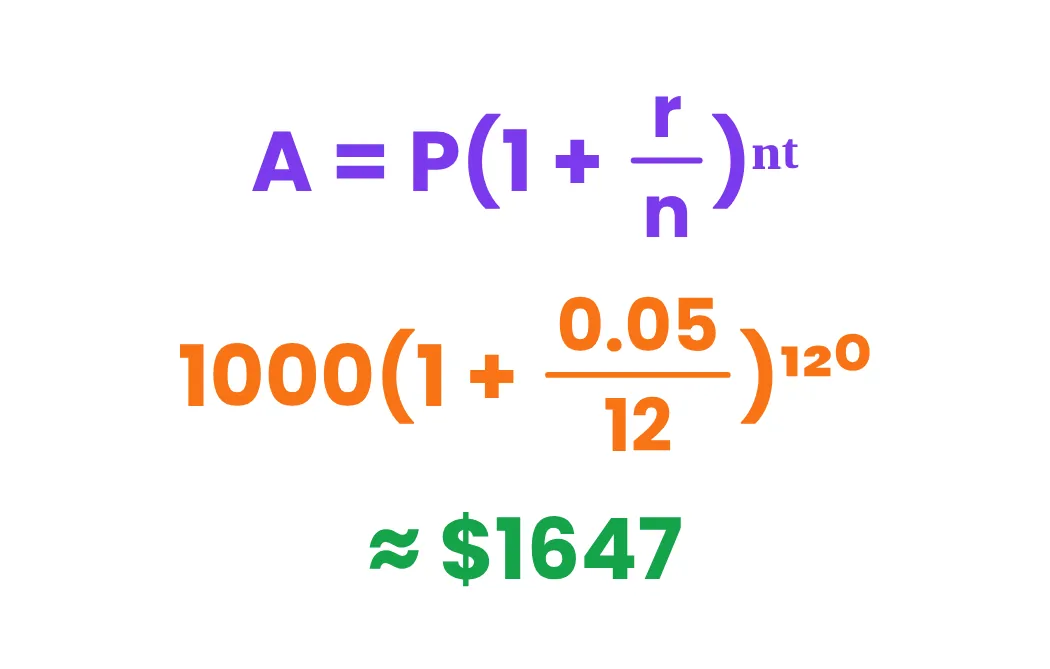
A = P(1 + r/n)ⁿᵗ
How does money grow in a bank? Interest on interest!
Learn it, step by step
1. The formula
P is the start, r the yearly rate, n the times compounded per year, t the years.
$1000 at 5% compounded monthly for 10 years: 1000(1 + 0.05/12)¹²⁰ ≈ $1647.
A = P(1 + r/n)ⁿᵗ
1000(1 + 0.05/12)¹²⁰
≈ $1647
2. More often is more
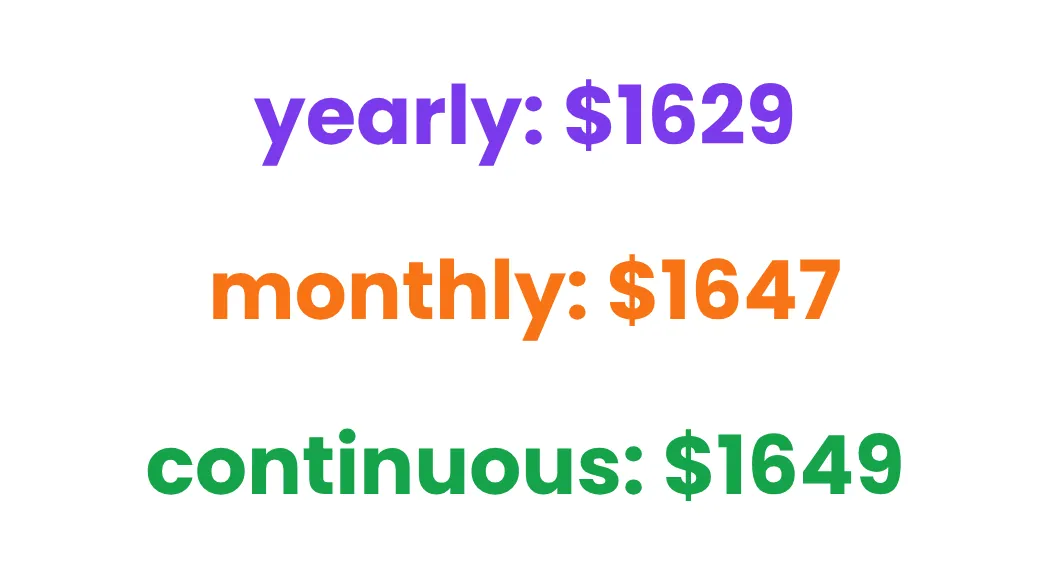
Yearly gives $1629. Monthly $1647. Continuously, A = Peʳᵗ, gives $1649.
yearly: $1629
monthly: $1647
continuous: $1649
3. Continuous
A = Peʳᵗ, with e ≈ 2.718.
A = Peʳᵗ

4. Rule of 72: step by step
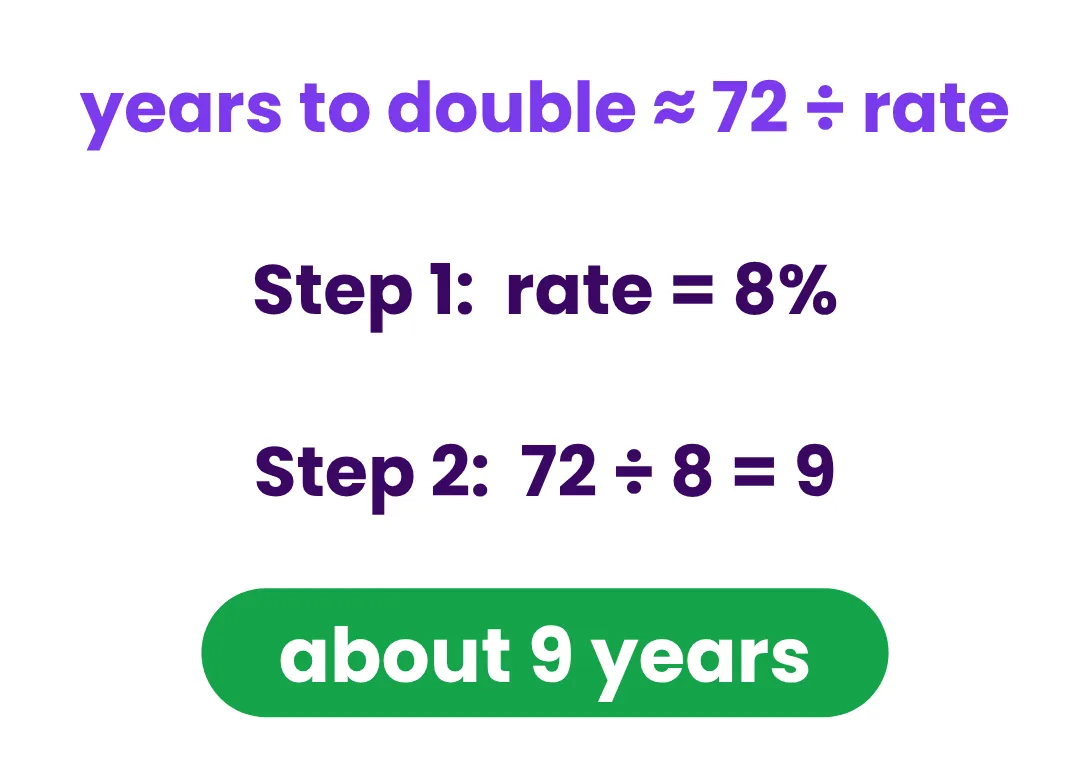
How long does money take to double? The Rule of 72 gives a quick estimate.
Step 1. Take the interest rate as a number. At 8 percent, use 8.
Step 2. Divide 72 by it: 72 ÷ 8 = 9. The money doubles in about 9 years.
years to double ≈ 72 ÷ rate
Step 1: rate = 8%
Step 2: 72 ÷ 8 = 9
about 9 years
Watch out: Rate as a decimal
5% is 0.05, not 5.
Wrong: 1000(1 + 5/12). Right: 1000(1 + 0.05/12).
Your turn
$500 at 4% compounded yearly for 2 years.
500(1.04)²
Answer: $540.80. 500 × 1.0816 = $540.80!
Remember
A = P(1 + r/n)ⁿᵗ. Continuous: A = Peʳᵗ.
A = P(1 + r/n)ⁿᵗ
Watch the Compound Interest lesson and practice · Printable worksheet