Proofs with Angles notes (Geometry)
Write proofs involving angle relationships.
The big question
Statement | Reason
How do we prove something in geometry? Step by step, with a reason for each!
Learn it, step by step
1. Two-column proof
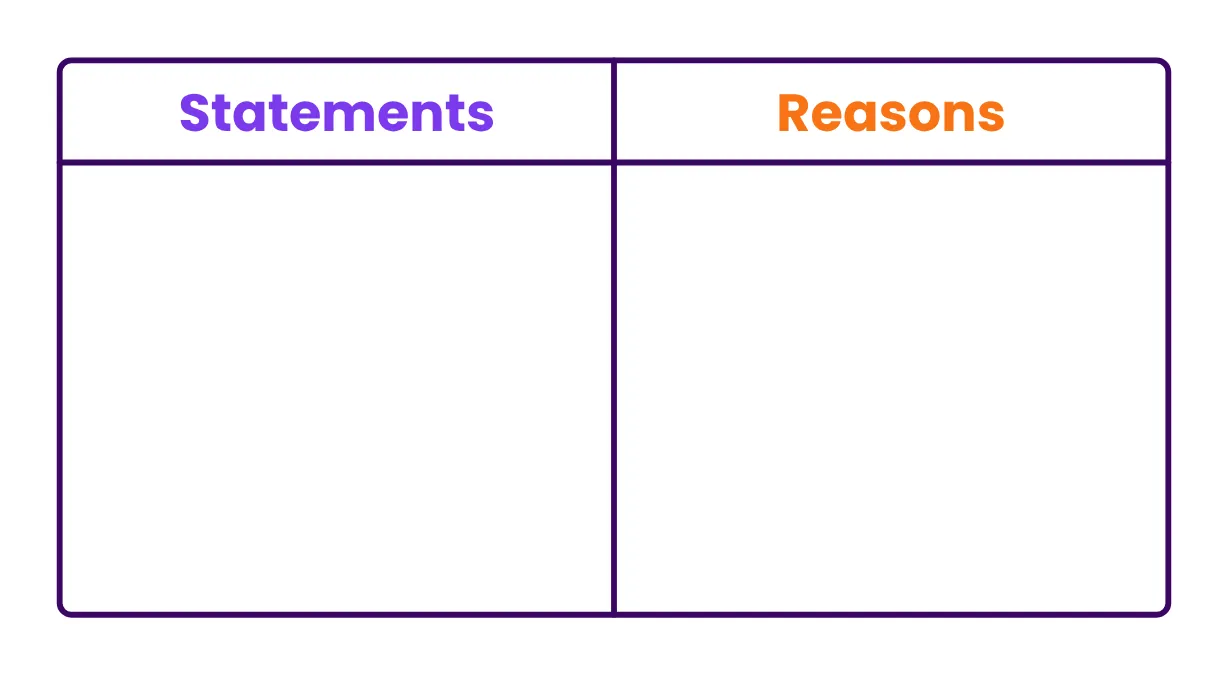
A proof lists statements on the left and the reason for each on the right.
Reasons are givens, definitions, postulates, or theorems already proved.
Statements
Reasons
2. Prove: vertical angles are equal
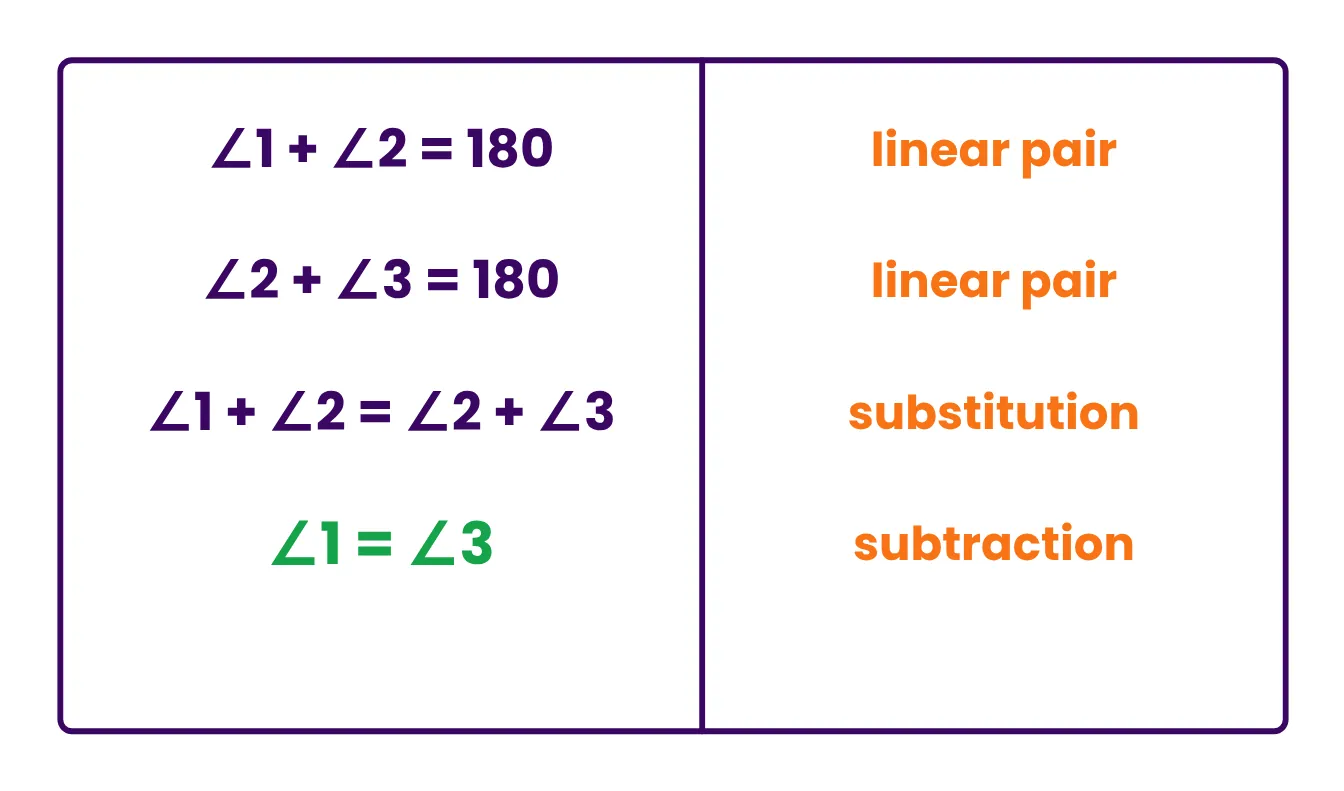
∠1 and ∠2 form a linear pair, so ∠1 + ∠2 = 180. ∠2 and ∠3 also: ∠2 + ∠3 = 180.
So ∠1 + ∠2 = ∠2 + ∠3. Subtract ∠2: ∠1 = ∠3.
∠1 + ∠2 = 180
linear pair
∠2 + ∠3 = 180
∠1 + ∠2 = ∠2 + ∠3
substitution
∠1 = ∠3
subtraction
3. Common reasons
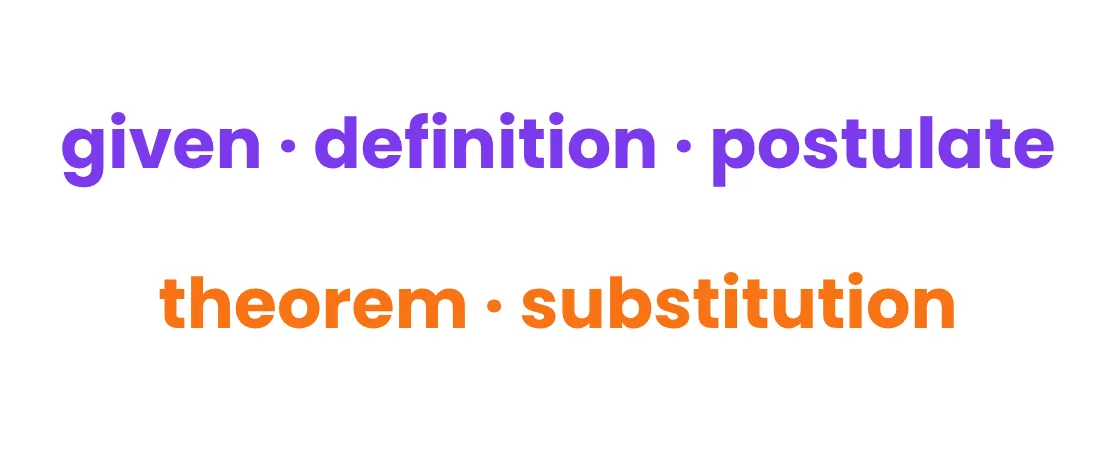
Definition of a linear pair, vertical angles theorem, substitution, and the properties of equality.
Each step must follow from earlier ones.
given · definition · postulate
theorem · substitution
Watch out: Every step needs a reason
"It looks equal" is not a reason. Use a definition, postulate, or theorem.
Wrong: looks equal. Right: vertical angles theorem.
Your turn
Given ∠A = ∠B and ∠B = ∠C. What reason shows ∠A = ∠C?
∠A = ∠B, ∠B = ∠C
Answer: transitive property. The transitive property!
Remember
Start with the givens. Each statement has a reason. End with what you want to prove.
given → … → prove
Watch the Proofs with Angles lesson and practice · Printable worksheet