Deductive Reasoning notes (Geometry)
Use logic and counterexamples in proofs.
The big question
∴
How do we reach a conclusion that must be true? Deductive reasoning!
Learn it, step by step
1. Inductive vs deductive
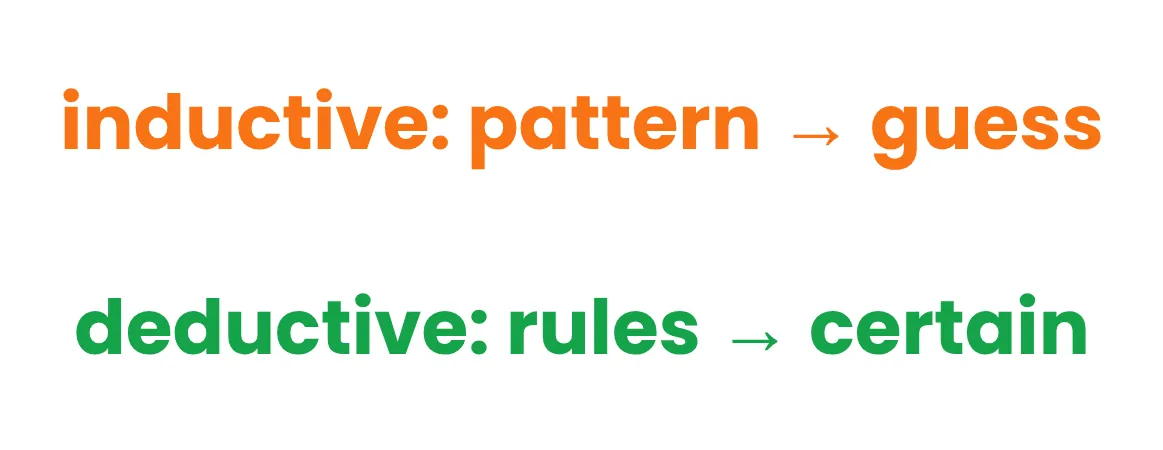
Inductive: spot a pattern from examples. The sun rose every day, so it will rise tomorrow.
Deductive: use facts and rules. The conclusion must be true.
inductive: pattern → guess
deductive: rules → certain
2. Law of detachment
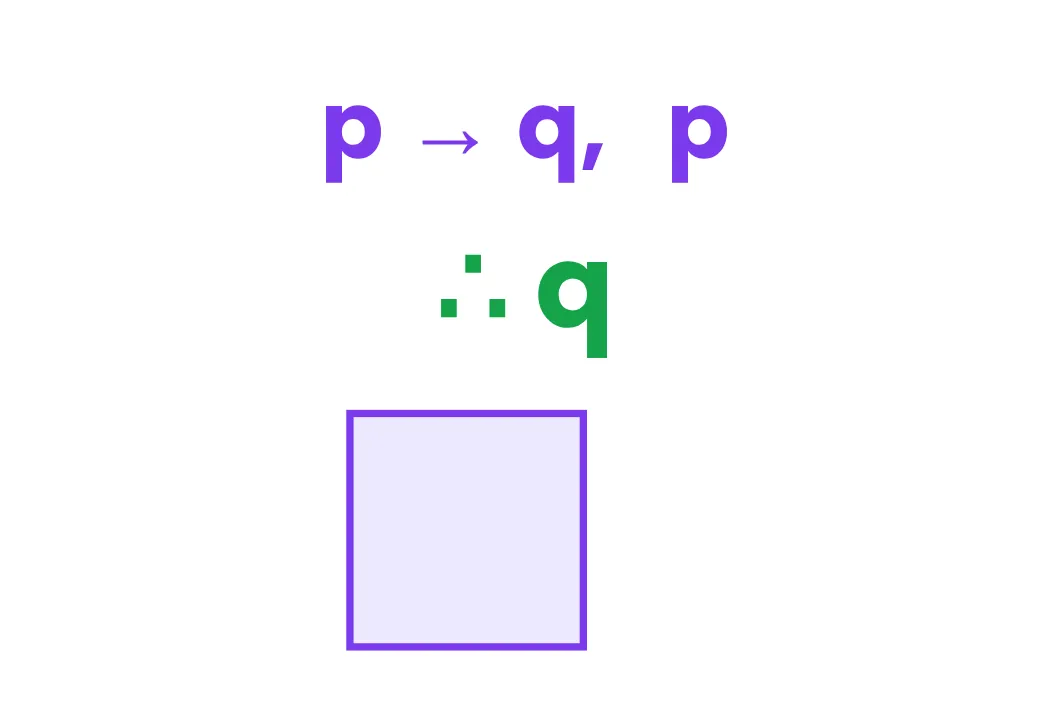
If p → q is true, and p is true, then q is true.
If it's a square, it has 4 right angles. ABCD is a square. So ABCD has 4 right angles.
p → q, p
3. Law of syllogism
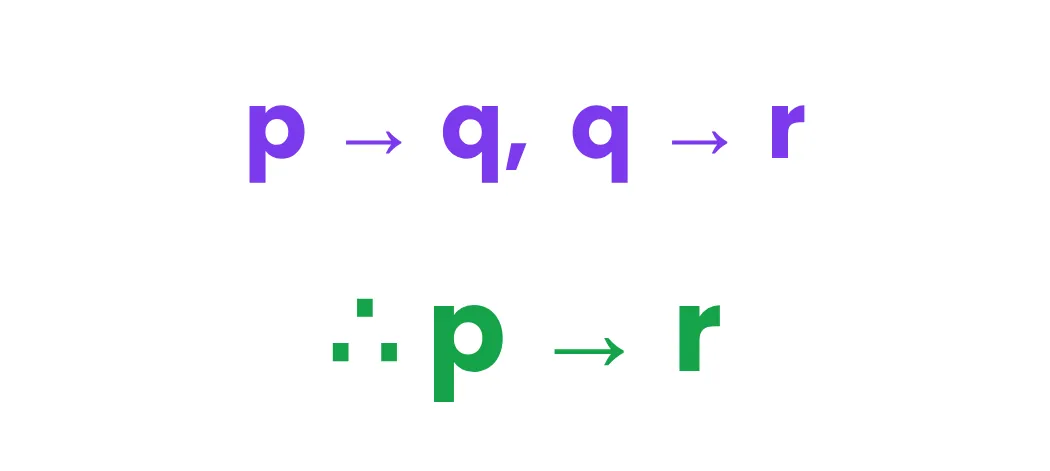
If p → q and q → r, then p → r. Chain them.
If it's a square, it's a rhombus. If it's a rhombus, its diagonals are perpendicular. So a square's diagonals are perpendicular.
p → q, q → r
∴ p → r
Watch out: Don't go backwards
If p → q and q is true, you can't conclude p. Wet ground doesn't prove it rained.
Wrong: q true → p true. Right: q true → p unknown.
Your turn
If x > 5, then x > 3. And x = 8. What can you conclude?
x > 5 → x > 3, x = 8
Answer: x > 3. 8 is greater than 5, so 8 is greater than 3. Detachment!
Remember
Deductive reasoning uses rules to reach certain conclusions.
Detachment: p → q and p, so q. Syllogism: chain the arrows.
p → q → r
Watch the Deductive Reasoning lesson and practice · Printable worksheet