Conditional Statements notes (Geometry)
Identify hypotheses, conclusions, and write conditionals.
The big question
If ..., then ...
How do mathematicians make claims? With if-then statements!
Learn it, step by step
1. Hypothesis and conclusion
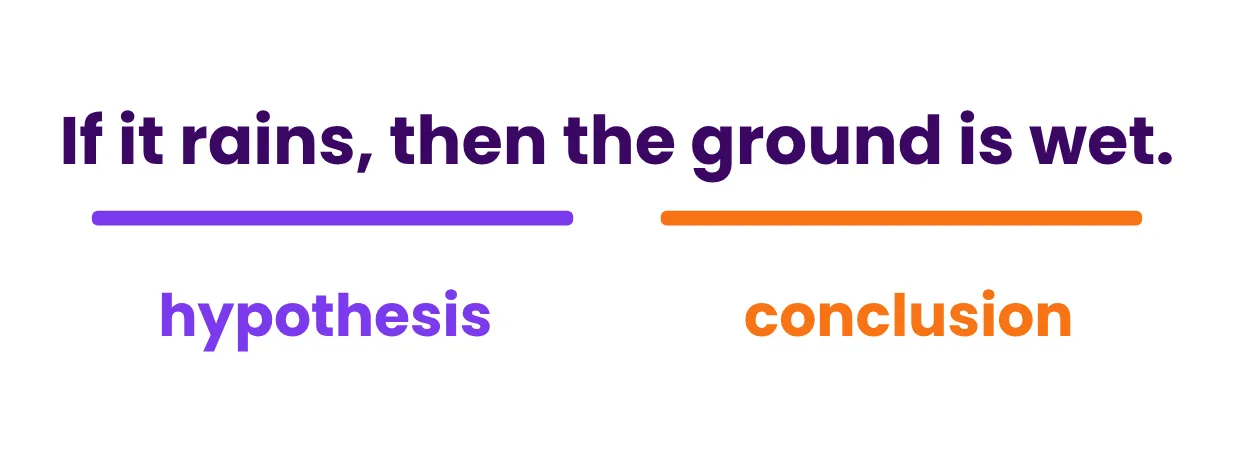
"If it is raining, then the ground is wet."
The "if" part is the hypothesis. The "then" part is the conclusion.
If it rains, then the ground is wet.
hypothesis
conclusion
2. In math
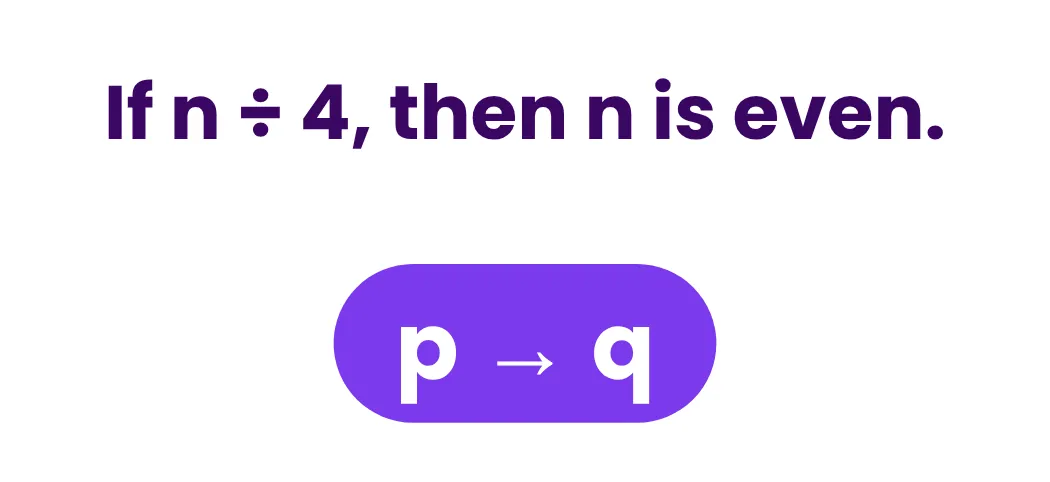
If a number is divisible by 4, then it is even. We write p → q.
p is the hypothesis, q the conclusion.
If n ÷ 4, then n is even.
3. Counterexamples
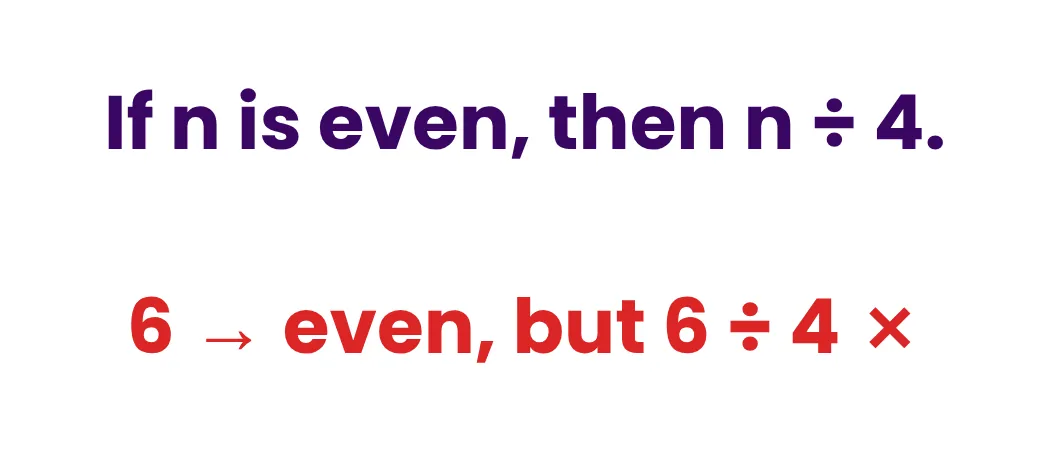
A statement is false if one case makes the hypothesis true and the conclusion false.
"If a number is even, it's divisible by 4." 6 is even but not divisible by 4. False!
If n is even, then n ÷ 4.
6 → even, but 6 ÷ 4 ✗
Watch out: One counterexample is enough
Many examples don't prove a statement true. But one counterexample proves it false.
Wrong: 5 examples work → true. Right: 1 counterexample → false.
Your turn
Write "All squares are rectangles" as an if-then statement.
All squares are rectangles.
Answer: If square, then rectangle.. If a shape is a square, then it is a rectangle!
Remember
If p, then q. p is the hypothesis, q is the conclusion.
A counterexample shows a statement is false.
Watch the Conditional Statements lesson and practice · Printable worksheet