Trigonometric Integrals notes (Calculus)
Integrate sine, cosine, and other trig functions.
The big question
∫ sin x dx
How do we integrate sine and cosine? Reverse the derivatives!
Learn it, step by step
1. The basic pairs
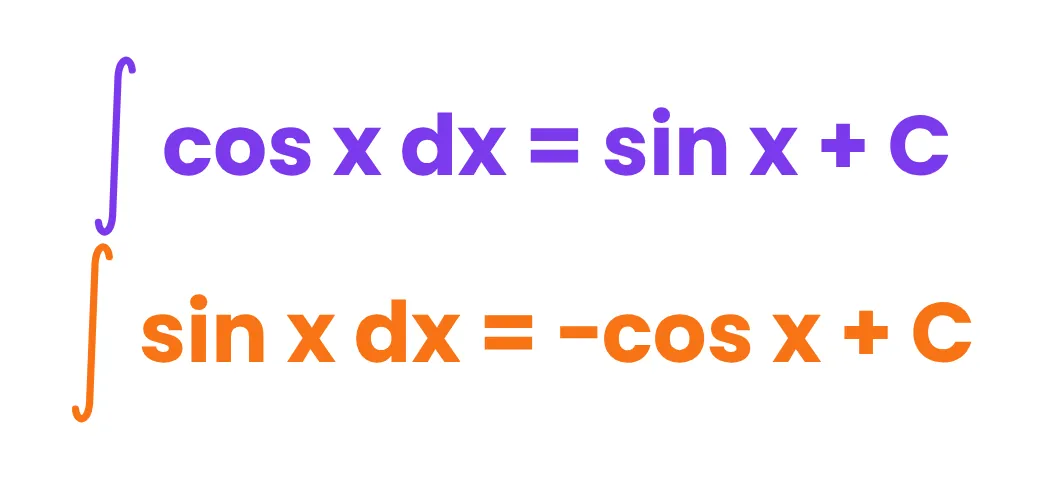
The derivative of sine is cosine, so the integral of cosine is sine.
The derivative of cosine is negative sine, so the integral of sine is negative cosine.
∫ cos x dx = sin x + C
∫ sin x dx = −cos x + C
2. More
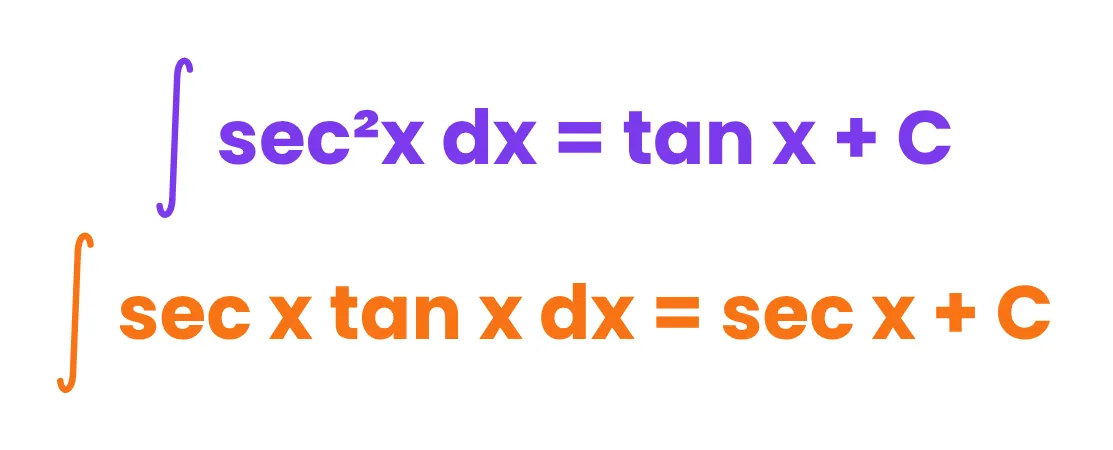
The integral of secant squared is tangent. The integral of secant tangent is secant.
∫ sec²x dx = tan x + C
∫ sec x tan x dx = sec x + C
3. Area under a hump
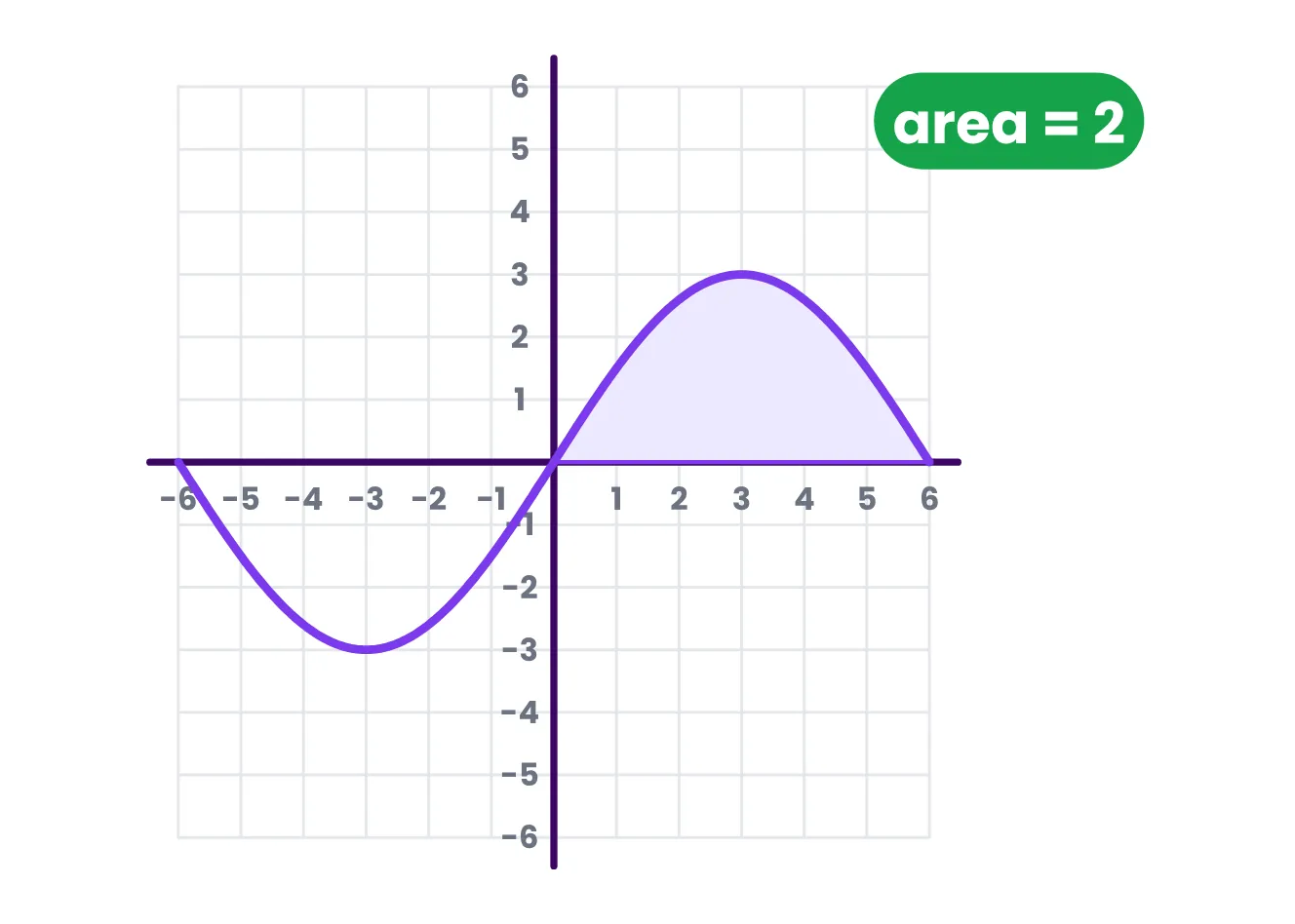
The area under sine from 0 to pi is negative cosine of pi, plus cosine of 0, which is 2.
area = 2
Watch out: Watch the sign
The integral of sine is negative cosine, not cosine.
Wrong: ∫ sin x = cos x. Right: ∫ sin x = −cos x.
Your turn
Integrate sine of x from 0 to pi over 2.
∫ sin x dx from 0 to π/2
Answer: 1. Negative cosine of pi over 2 is 0, plus cosine of 0 is 1. The answer is 1!
Remember
Integrate trig functions by reversing their derivatives.
∫ cos = sin, ∫ sin = −cos
Watch the Trigonometric Integrals lesson and practice · Printable worksheet