Riemann Sums notes (Calculus)
Approximate area using rectangles.
The big question
▮▮▮▮
How do we find the area under a curve? Fill it with rectangles!
Learn it, step by step
1. Rectangles under a curve
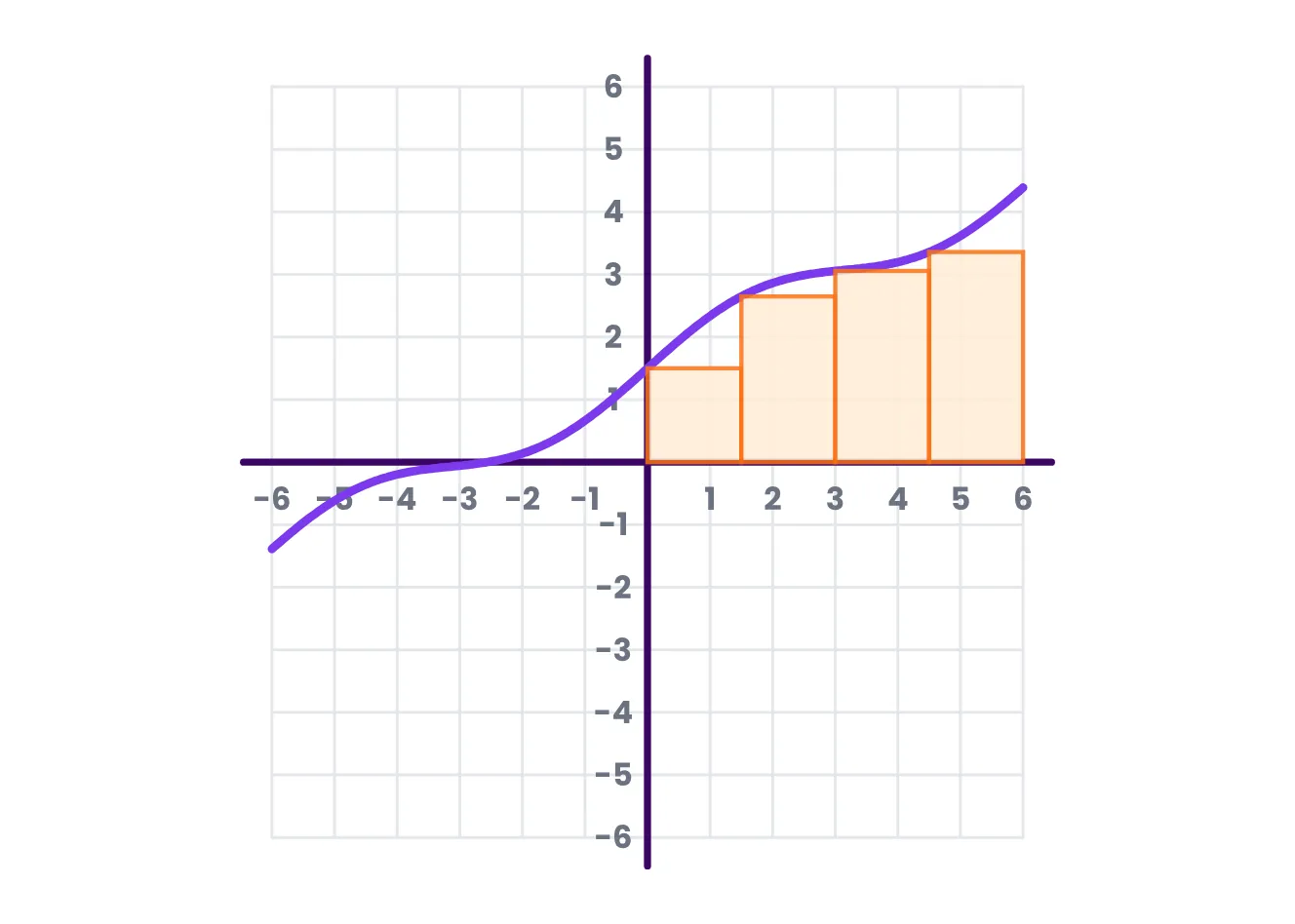
Split the interval into equal widths. Each rectangle's height is the function at one point.
Add up width times height for every rectangle.
2. More rectangles, better answer
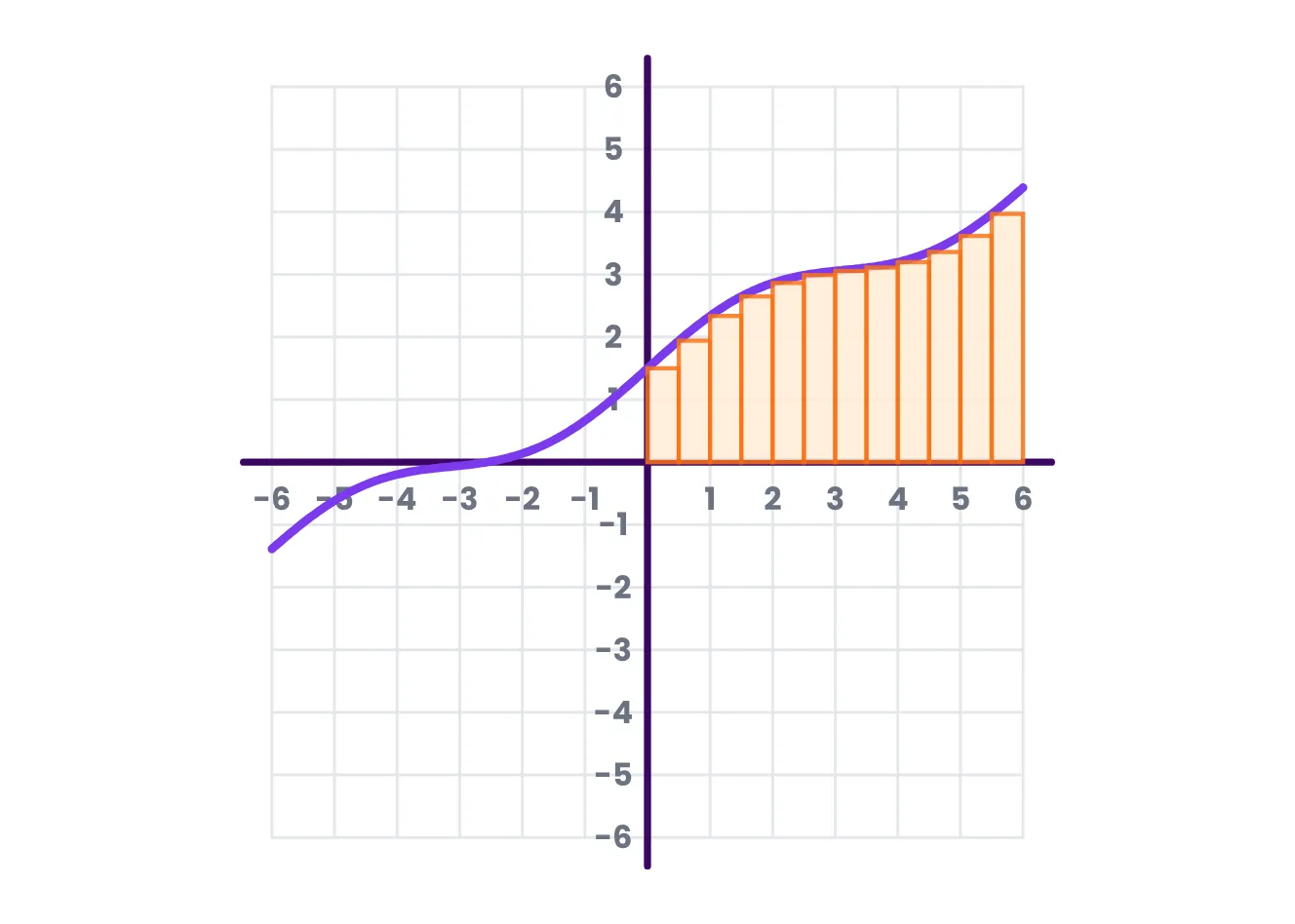
With 4 rectangles the estimate is rough. With 12, it is much closer.
As the number of rectangles goes to infinity, the sum becomes the exact area.
3. Left, right and midpoint
Left sums use the left edge for height, right sums use the right edge, midpoint sums use the middle.
left · right · midpoint

Watch out: Width times height
Each rectangle's area is width times height. Do not just add the heights.
Wrong: 2 + 4 = 6. Right: 2·2 + 2·4 = 12.
Your turn
Estimate the area under y equals x from 0 to 4 with 2 right rectangles.
y = x, [0, 4], 2 right rectangles
Answer: 12. Width 2. Heights 2 and 4. Area is 2 times 2 plus 2 times 4, which is 12!
Remember
A Riemann sum adds rectangle areas. More rectangles, closer to the true area.
Σ f(xᵢ) Δx
Watch the Riemann Sums lesson and practice · Printable worksheet