Related Rates notes (Calculus)
Connect rates that change together over time.
The big question
🎈
How fast does a balloon's radius grow as you blow air in? Related rates!
Learn it, step by step
1. Link the quantities
Write an equation linking the quantities, then take the derivative with respect to time.
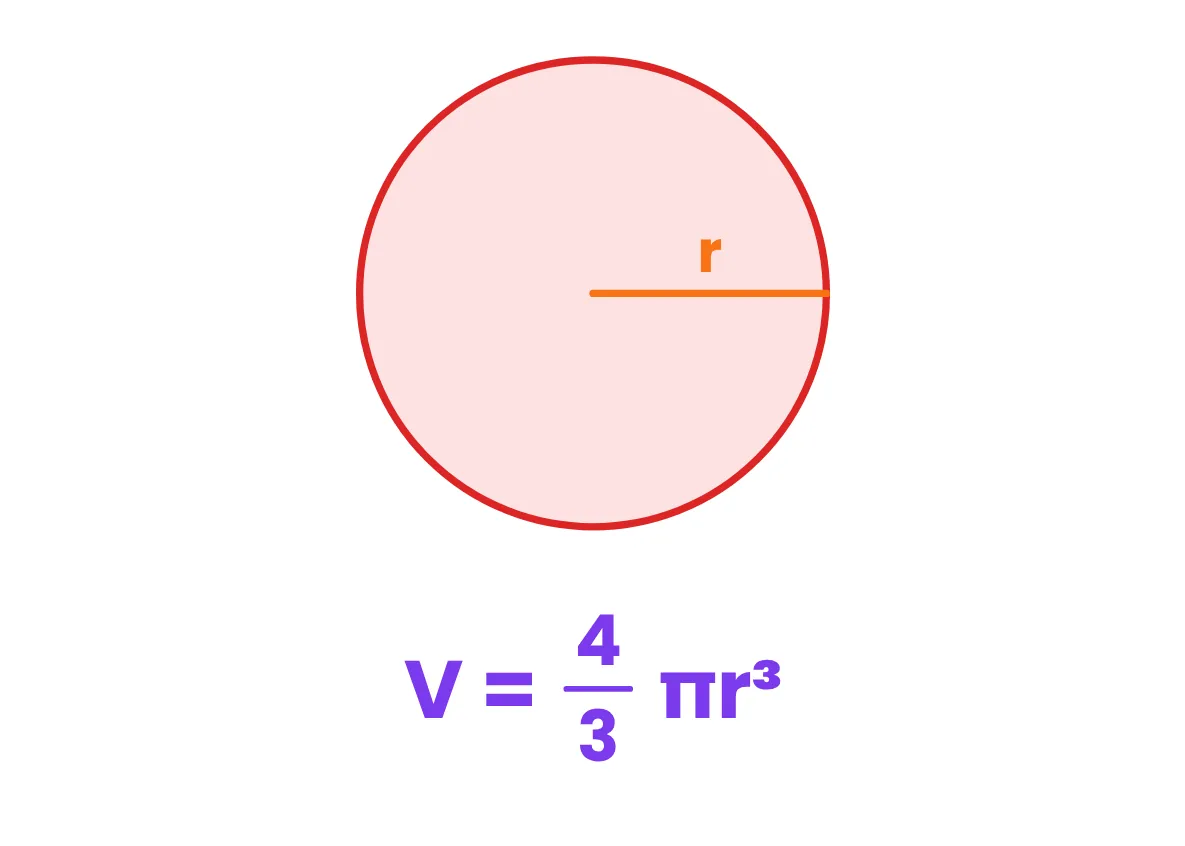
For a sphere: volume equals four thirds pi r cubed.
V = 4/3 πr³
2. Differentiate with time
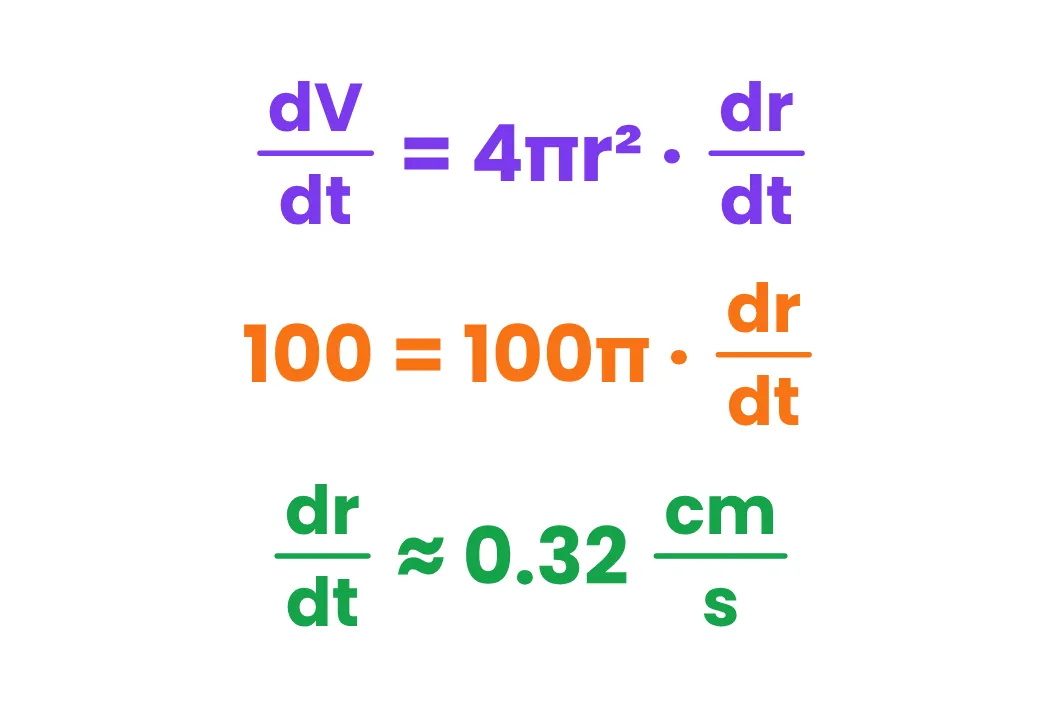
dV over dt equals 4 pi r squared, times dr over dt.
Air goes in at 100 cubic centimeters per second. When r is 5: 100 equals 100 pi times dr over dt. So dr over dt is 1 over pi, about 0.32 centimeters per second.
dV/dt = 4πr² · dr/dt
100 = 100π · dr/dt
dr/dt ≈ 0.32 cm/s
3. The steps
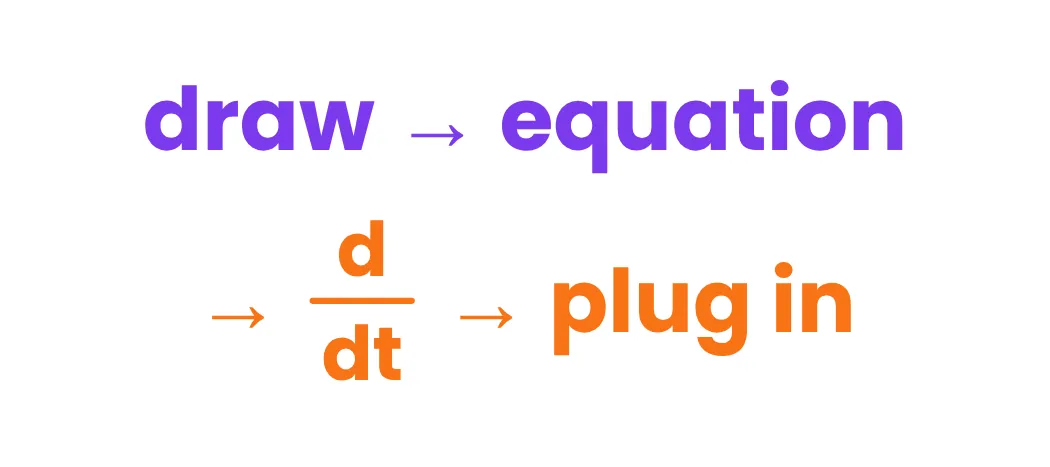
Draw it. Write the equation. Differentiate with respect to time. Plug in the known values last.
draw → equation
→ d/dt → plug in
Watch out: Plug in last
Differentiate first, then substitute the numbers. Plugging in early freezes the changing quantity.
Wrong: r = 5 first, then d/dt. Right: d/dt first, then r = 5.
Your turn
A square's side grows at 2 centimeters per second. How fast is its area growing when the side is 5?
A = s², ds/dt = 2, s = 5
Answer: 20 cm²/s. A equals s squared, so dA over dt equals 2s times ds over dt: 2 times 5 times 2, which is 20 square centimeters per second!
Remember
Relate the quantities, differentiate with respect to time, then substitute.
equation → d/dt → numbers
Watch the Related Rates lesson and practice · Printable worksheet