Fundamental Theorem notes (Calculus)
Apply the Fundamental Theorem of Calculus.
The big question
d/dx ∫
How are derivatives and integrals related? They undo each other!
Learn it, step by step
1. Part one: accumulation
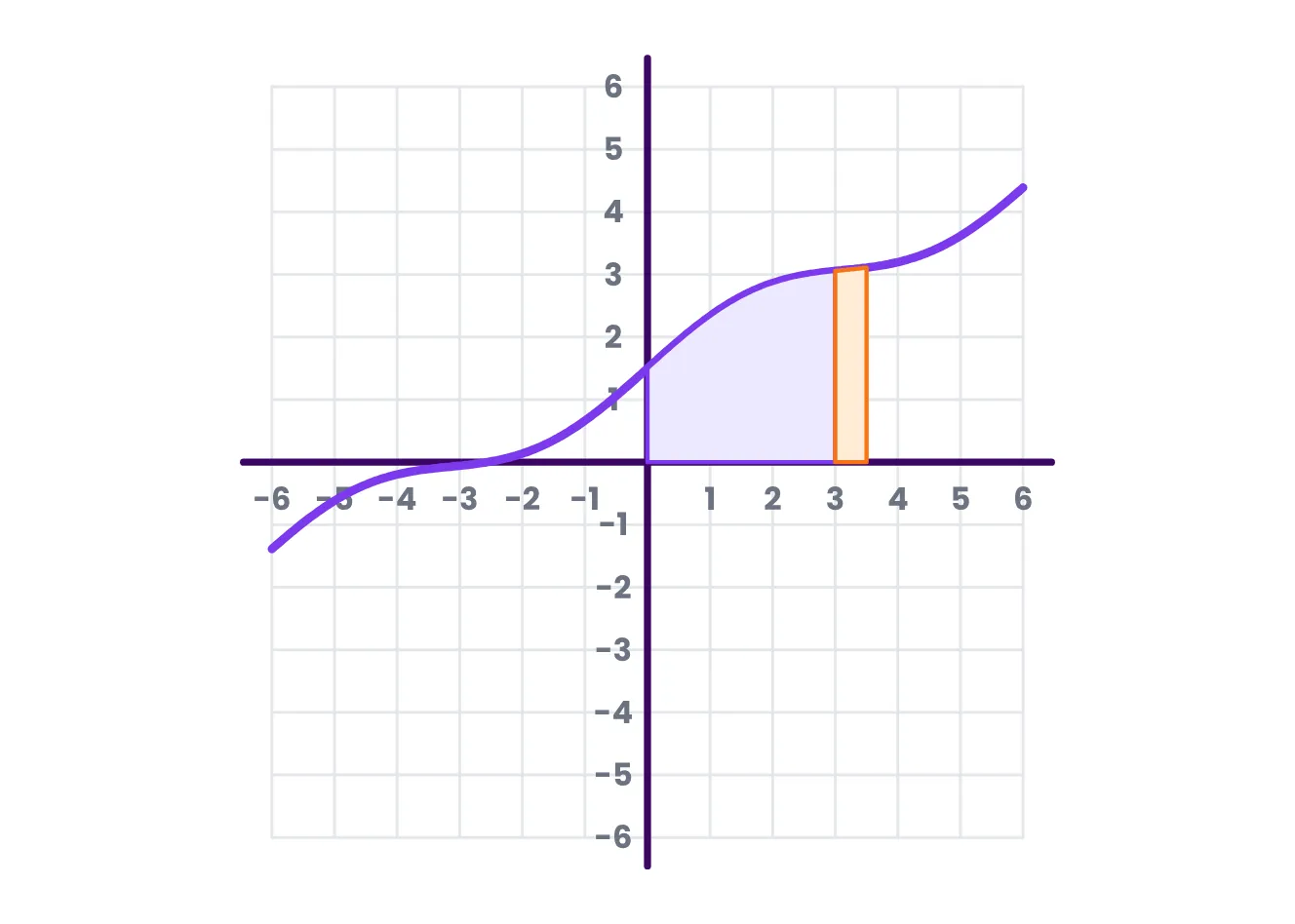
Let A of x be the area under f from a fixed start up to x.
As x moves right, the area grows at a rate equal to f of x. So the derivative of A is f.
2. Part two: evaluation
To find the area from a to b, use any antiderivative: F of b minus F of a.
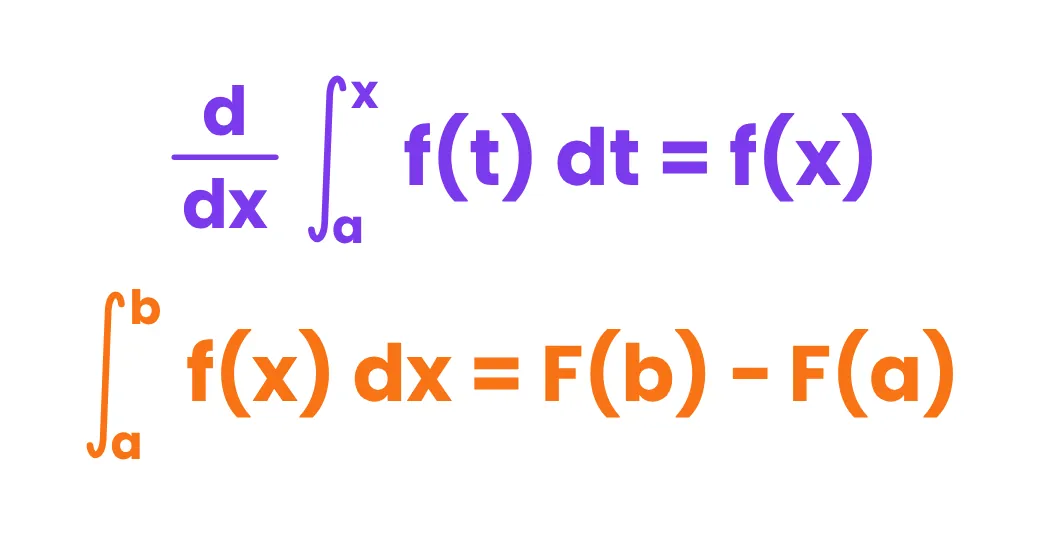
d/dx ∫ₐˣ f(t) dt = f(x)
∫ₐᵇ f(x) dx = F(b) − F(a)
3. Example of part one
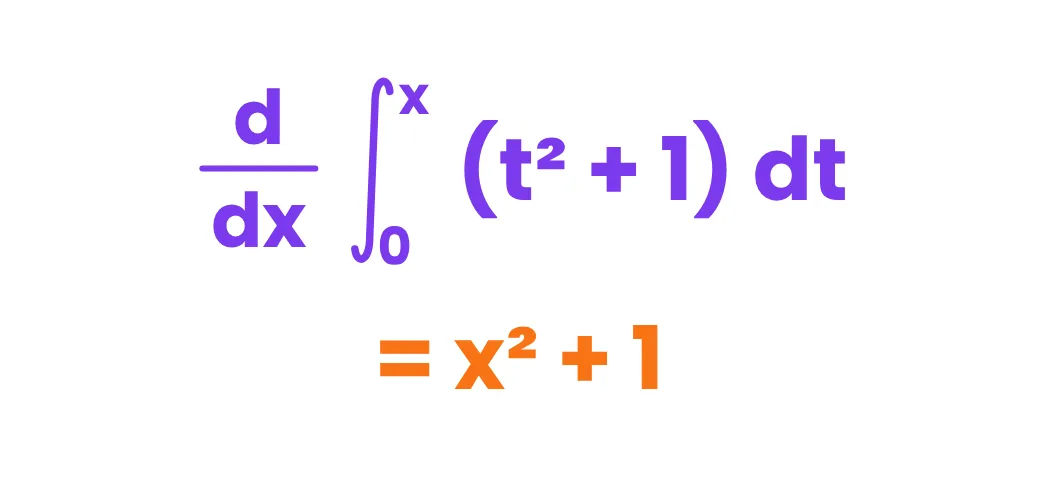
The derivative of the integral from 0 to x of t squared plus 1 is just x squared plus 1.
d/dx ∫₀ˣ (t² + 1) dt
= x² + 1
Watch out: With a function on top
If the top limit is x squared, multiply by its derivative, 2x: that is the chain rule.
Wrong: d/dx ∫₀ to x² f = f(x²). Right: = f(x²) · 2x.
Your turn
What is the derivative of the integral from 2 to x of the cosine of t?
d/dx ∫₂ˣ cos t dt
Answer: cos x. Just cosine of x!
Remember
Differentiation and integration are inverse processes.
d/dx ∫ = f
Watch the Fundamental Theorem lesson and practice · Printable worksheet