Derivative Definition notes (Calculus)
Find derivatives using the limit definition.
The big question
slope of a curve
How steep is a curve at one point? Zoom in until it looks straight!
Learn it, step by step
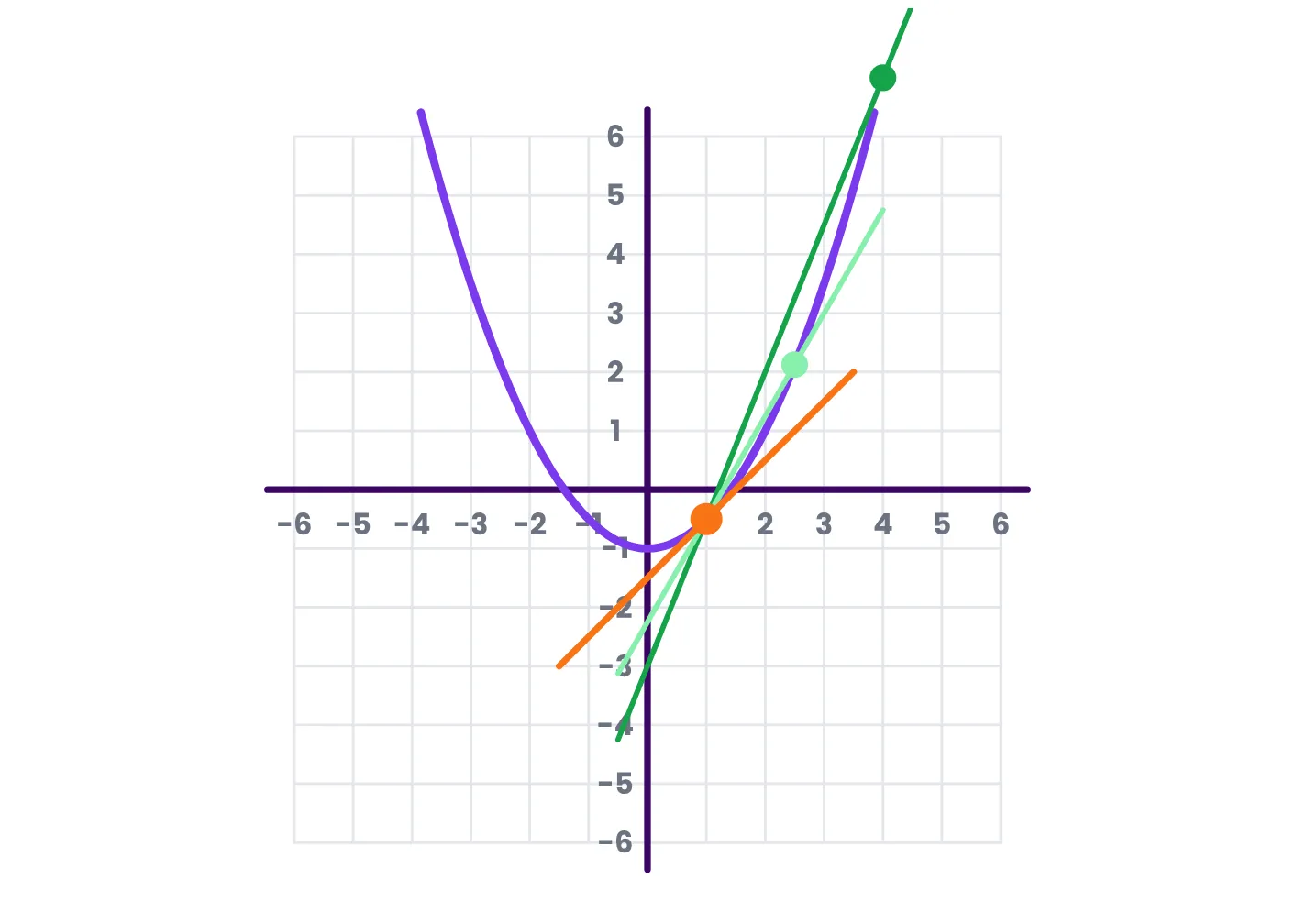
1. From secant to tangent
A secant line through two points has slope: change in y over change in x.
Slide the second point closer and closer. The secant turns into the tangent line.
2. The formula
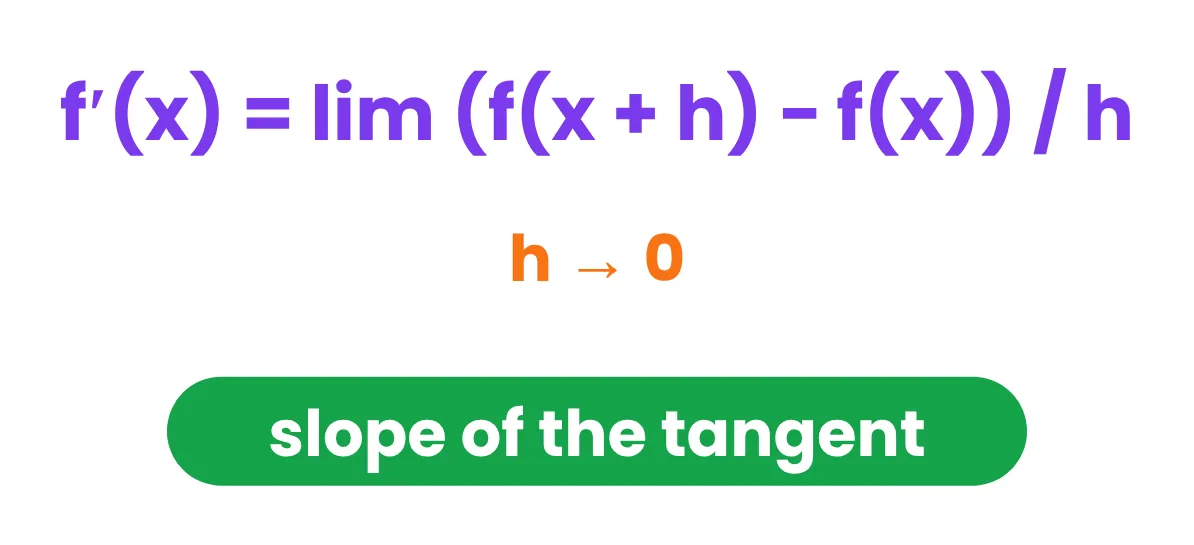
The derivative is the limit, as h goes to zero, of f of x plus h, minus f of x, all over h.
It is the slope of the tangent line, the instant rate of change.
f′(x) = lim (f(x + h) − f(x)) / h
h → 0
slope of the tangent
3. Example
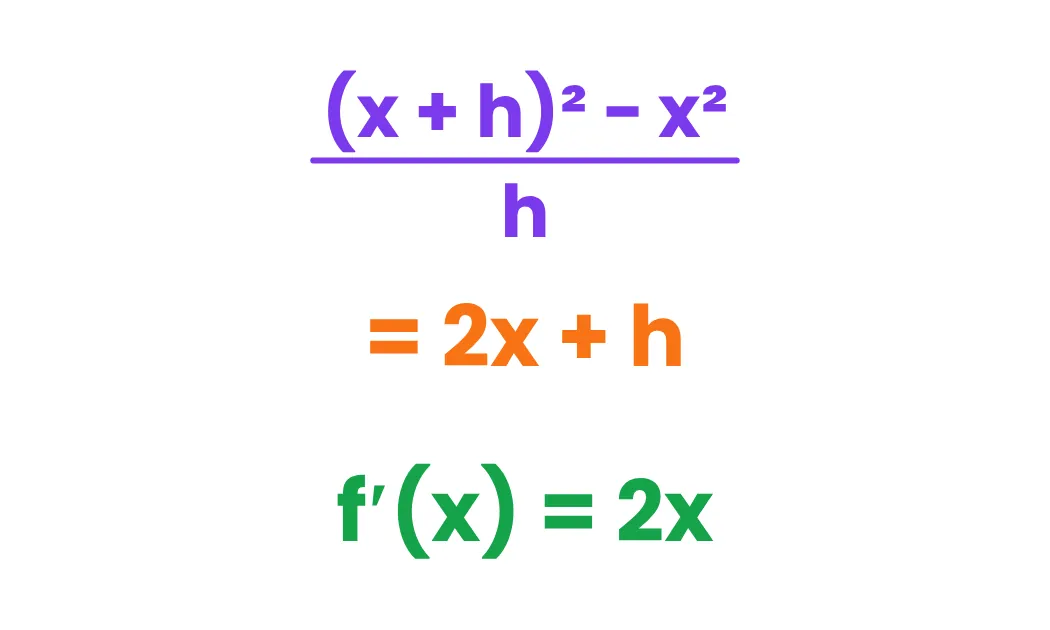
For f of x equals x squared: x plus h, squared, minus x squared is 2xh plus h squared.
Divide by h: 2x plus h. As h goes to zero: the derivative is 2x.
((x + h)² − x²)/h
= 2x + h
f′(x) = 2x
Watch out: Tangent, not secant
The derivative is the slope at one point, not between two points.
Wrong: slope between two points. Right: slope at one point.
Your turn
Using the result, what is the slope of y equals x squared at x equals 3?
f′(x) = 2x, x = 3
Answer: slope = 6. The derivative is 2x, so the slope is 6!
Remember
The derivative is the limit of the difference quotient: the slope of the tangent line.
f′(x) = lim (f(x + h) − f(x))/h
Watch the Derivative Definition lesson and practice · Printable worksheet