Chain Rule notes (Calculus)
Differentiate composite functions.
The big question
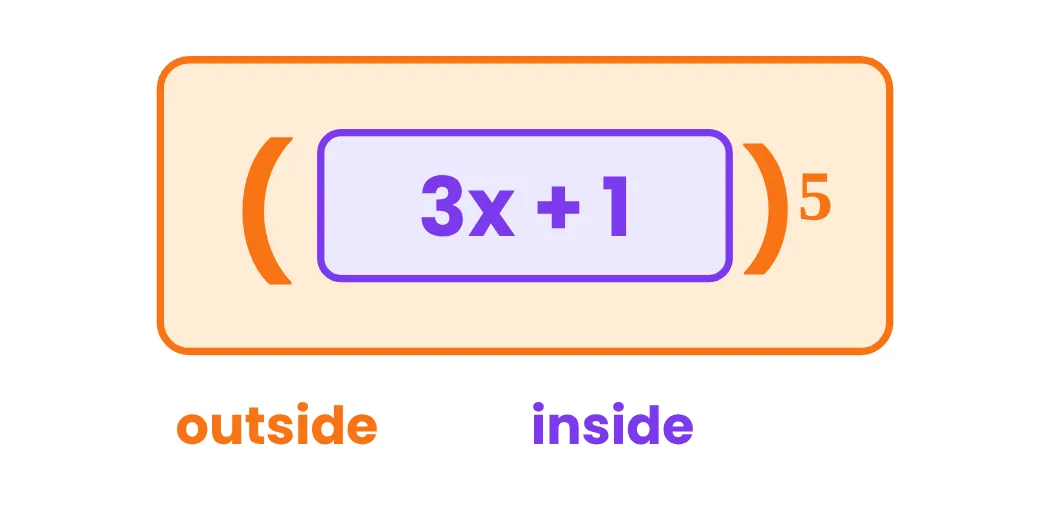
(3x + 1)⁵
How do we differentiate a function inside a function? The chain rule!
Learn it, step by step
1. Outside, then inside
Think of an outside function and an inside function.
Take the derivative of the outside, keep the inside the same, then multiply by the derivative of the inside.
3x + 1
outside
inside
2. Example
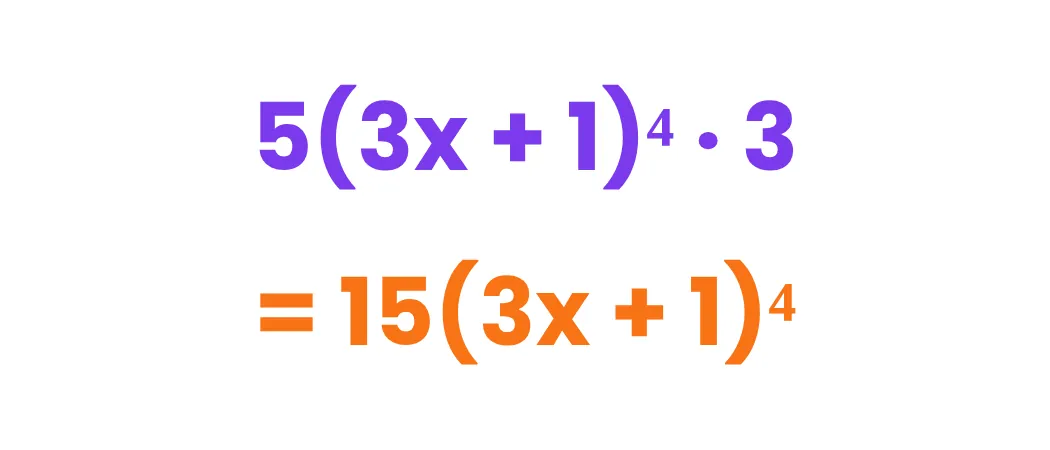
For 3x plus 1, to the fifth: the outside gives 5 times 3x plus 1 to the fourth.
Times the inside derivative, 3. The answer is 15 times 3x plus 1, to the fourth.
5(3x + 1)⁴ · 3
= 15(3x + 1)⁴
3. With other functions
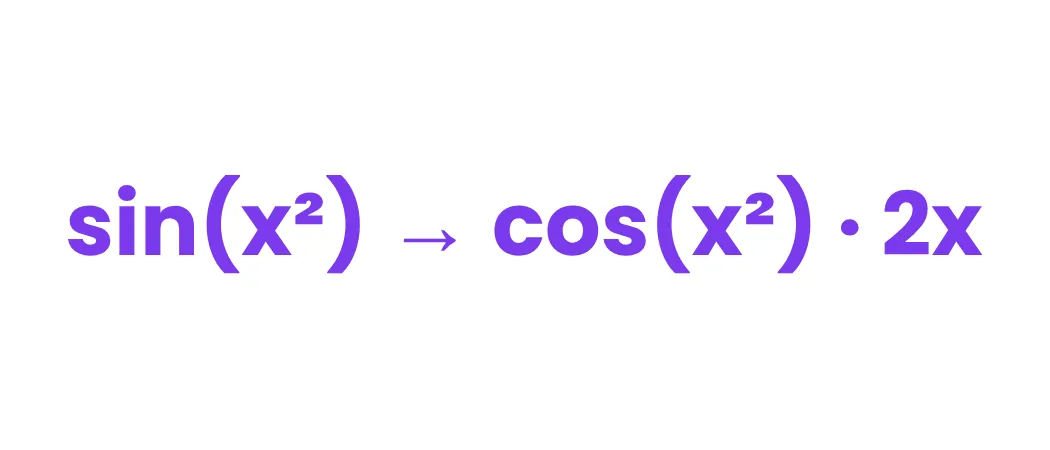
The derivative of sine of x squared is cosine of x squared, times 2x.
sin(x²) → cos(x²) · 2x
Watch out: Multiply by the inside
Do not forget the derivative of the inside.
Wrong: (3x + 1)⁵ → 5(3x + 1)⁴. Right: (3x + 1)⁵ → 5(3x + 1)⁴ · 3.
Your turn
Differentiate x squared plus 1, to the third power.
(x² + 1)³
Answer: 6x(x² + 1)². 3 times x squared plus 1, squared, times 2x. That is 6x times x squared plus 1, squared!
Remember
Derivative of the outside, times derivative of the inside.
f(g(x))′ = f′(g(x))·g′(x)
Watch the Chain Rule lesson and practice · Printable worksheet