Implicit Differentiation notes (AP Calculus BC)
Find dy/dx when y is not alone.
The big question
x² + y² = 25
How do we find the slope when y is not alone? Differentiate both sides!
Learn it, step by step
1. Treat y as a function of x
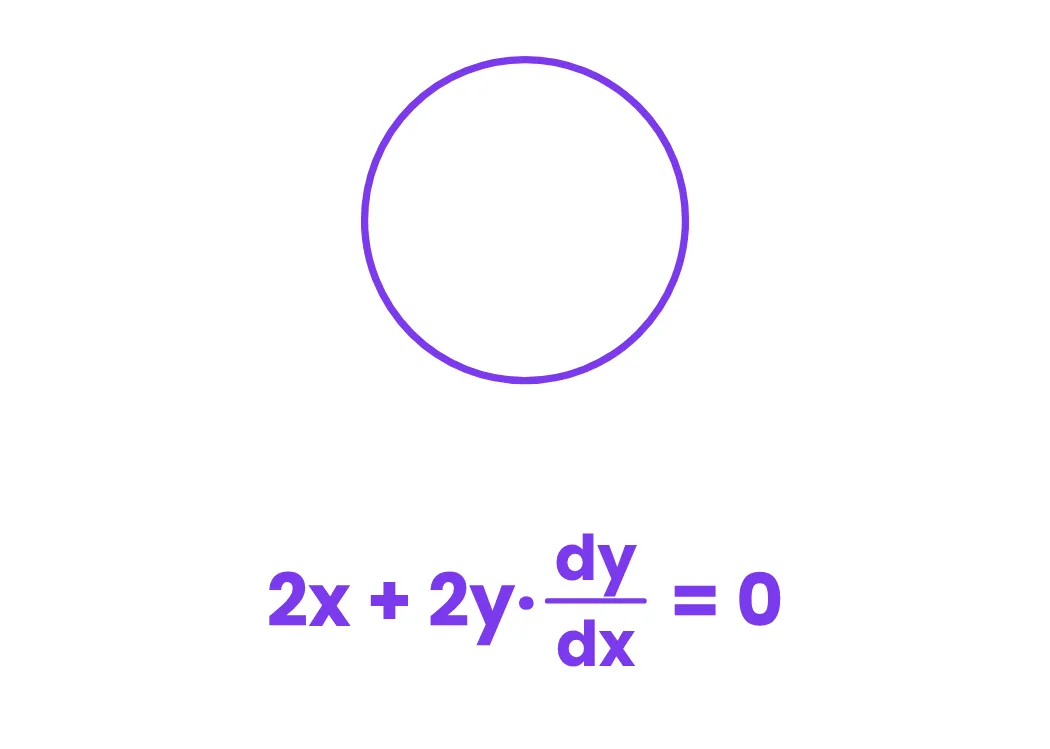
Take the derivative of every term. Each time you differentiate a y term, multiply by dy over dx.
x squared plus y squared equals 25 gives 2x plus 2y times dy over dx equals 0.
2x + 2y·dy/dx = 0
2. Solve for dy over dx
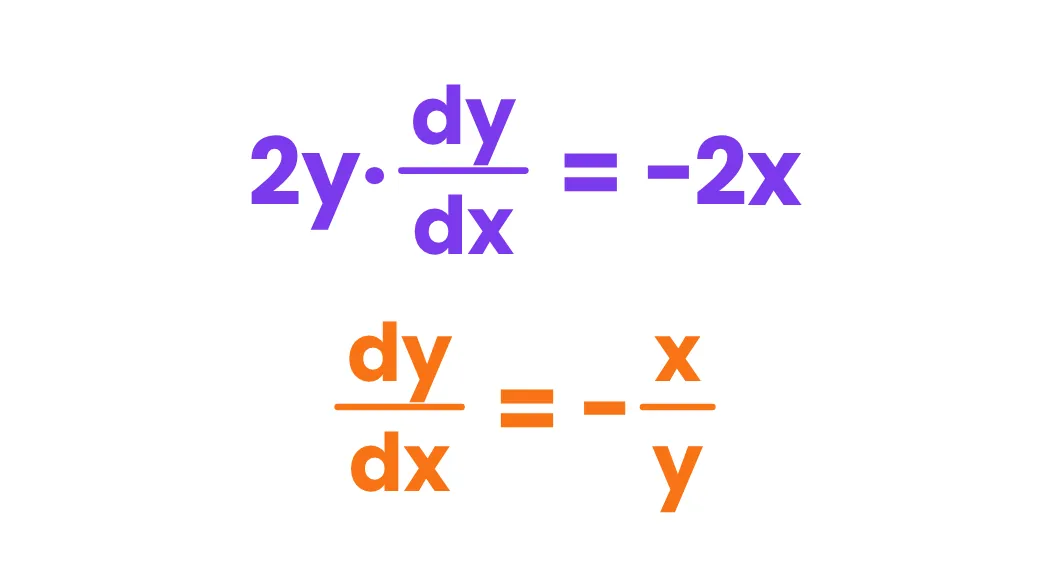
Move the 2x: 2y times dy over dx equals negative 2x.
Divide: dy over dx equals negative x over y.
2y·dy/dx = −2x
dy/dx = −x/y
3. Use it
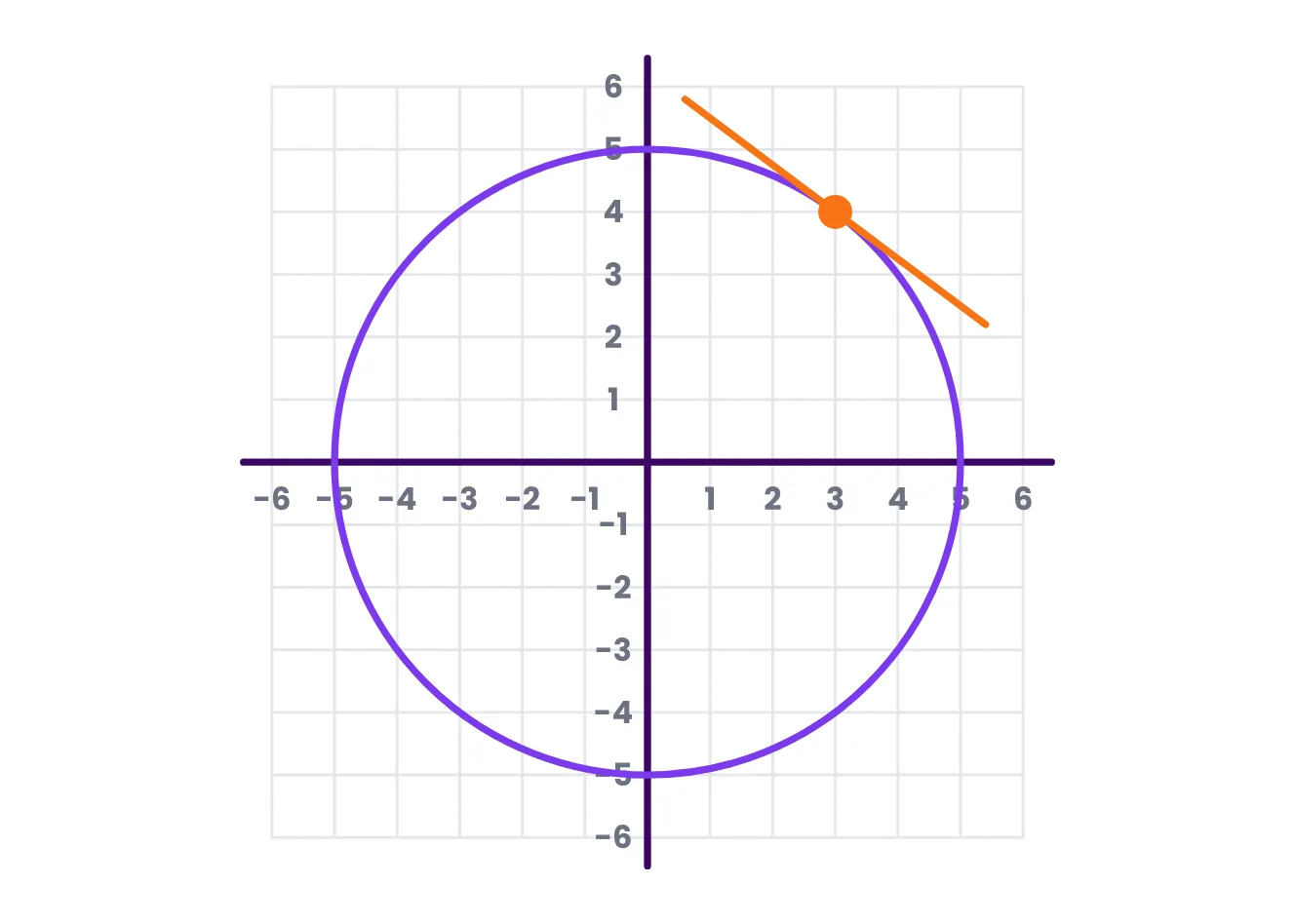
At the point 3, 4 on the circle, the slope is negative 3 over 4.
Watch out: The dy over dx on y terms
The derivative of y squared is 2y times dy over dx, not just 2y.
Wrong: d/dx(y²) = 2y. Right: d/dx(y²) = 2y·dy/dx.
Your turn
If x times y equals 6, find dy over dx.
xy = 6
Answer: dy/dx = −y/x. y plus x times dy over dx equals 0, so dy over dx equals negative y over x!
Remember
Differentiate both sides, attach dy over dx to y terms, and solve for dy over dx.
dy/dx = −x/y
Watch the Implicit Differentiation lesson and practice · Printable worksheet