Vector Calculus notes (AP Calculus BC)
Vector-valued functions and motion.
The big question
⟨x(t), y(t)⟩
How do we describe motion in a plane? With vectors!
Learn it, step by step
1. Position, velocity, acceleration
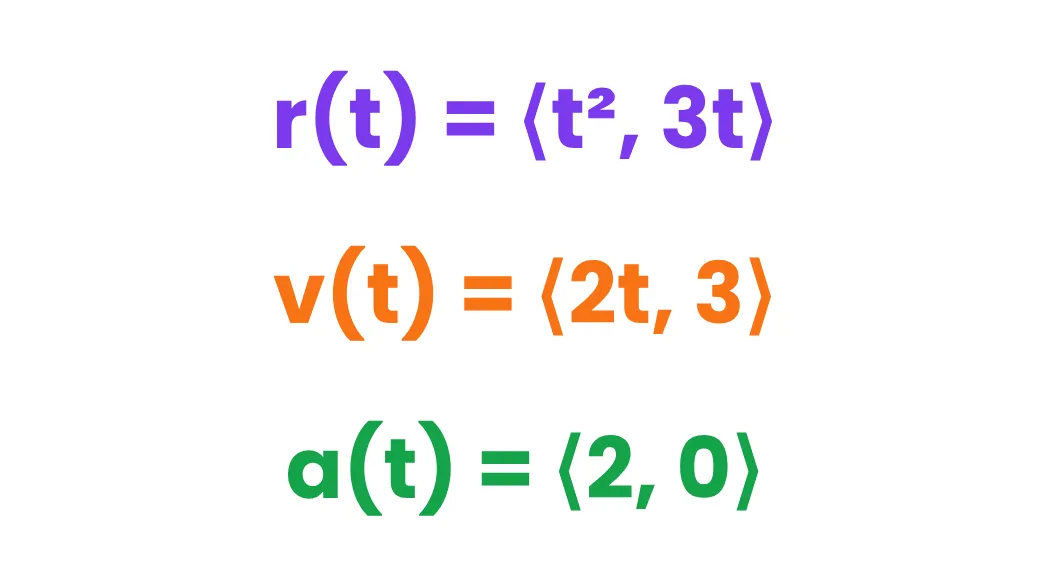
A position vector is x of t, y of t. Differentiate each part to get velocity, then acceleration.
r(t) = ⟨t², 3t⟩
v(t) = ⟨2t, 3⟩
a(t) = ⟨2, 0⟩
2. Speed
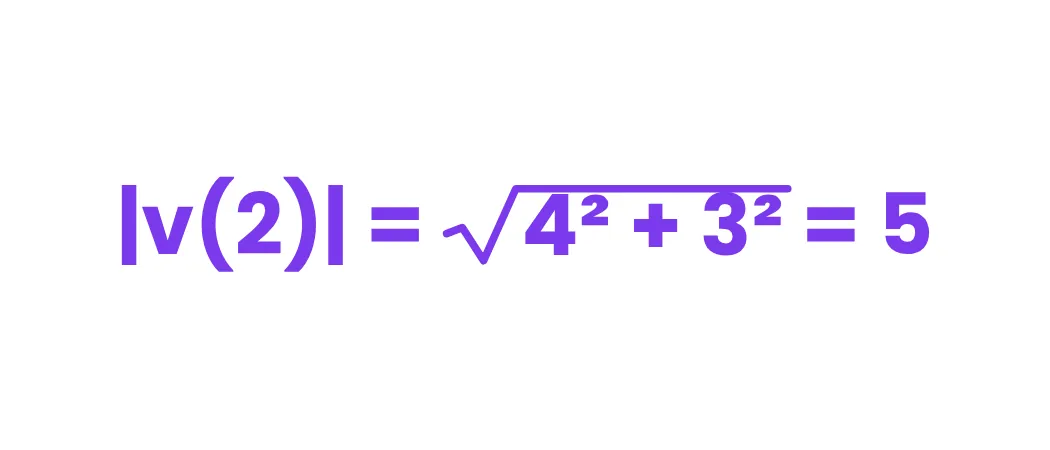
Speed is the length of the velocity vector. At t equals 2: the square root of 16 plus 9, which is 5.
|v(2)| = √(4² + 3²) = 5
Watch out: Speed is a length
Speed is the magnitude of velocity, a single number.
Wrong: speed = ⟨6, 8⟩. Right: speed = 10.
Your turn
Velocity is 6, 8 at some time. What is the speed?
v = ⟨6, 8⟩
Answer: 10. Square root of 36 plus 64 is 10!
Remember
Differentiate each component. Speed is the length of the velocity vector.
r → v → a
Watch the Vector Calculus lesson and practice · Printable worksheet