Applications notes (AP Calculus BC)
Rates of change, optimization, and area.
The big question
s · v · a
How does calculus describe motion? Position, velocity and acceleration!
Learn it, step by step
1. The chain of derivatives
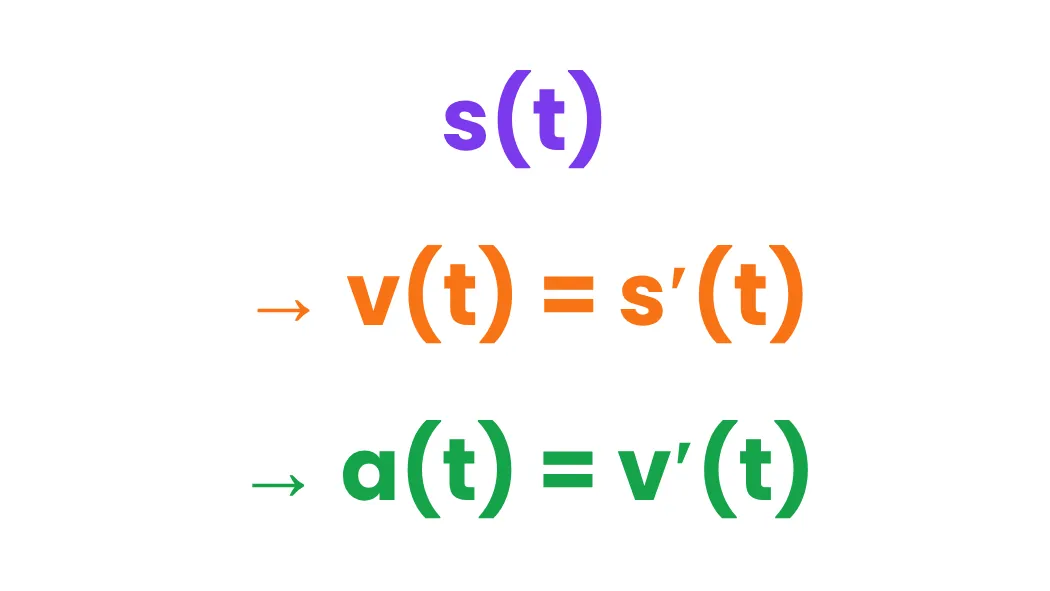
Velocity is the derivative of position. Acceleration is the derivative of velocity.
→ v(t) = s′(t)
→ a(t) = v′(t)
2. Speeding up or slowing down
If velocity and acceleration have the same sign, the object speeds up. Opposite signs: it slows down.
same signs → speeding up
opposite → slowing down

3. Displacement and distance
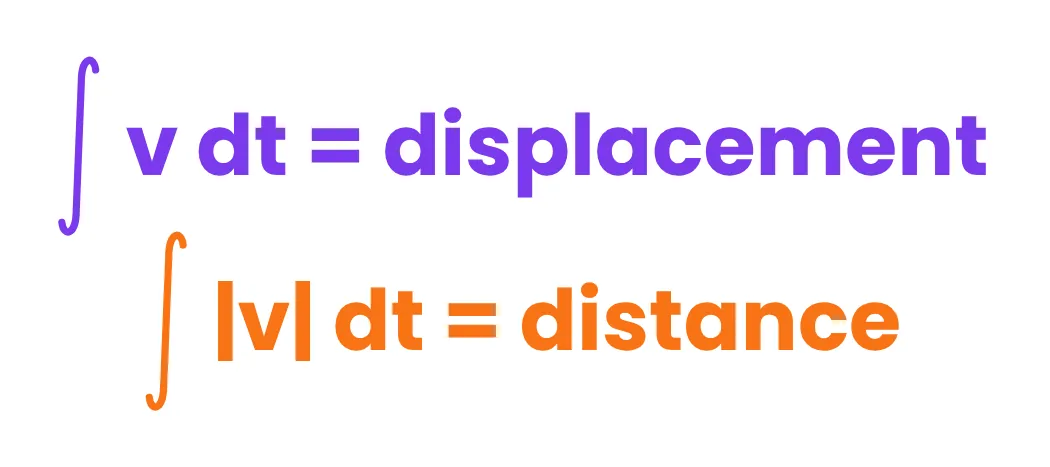
The integral of velocity gives displacement. The integral of speed, the absolute value of velocity, gives total distance.
∫ v dt = displacement
∫ |v| dt = distance
Watch out: Distance uses absolute value
Total distance needs the absolute value of velocity. Displacement does not.
Wrong: distance = ∫ v dt. Right: distance = ∫ |v| dt.
Your turn
Velocity is negative 3 and acceleration is negative 2. Speeding up or slowing down?
v = −3, a = −2
Answer: speeding up. Same signs: speeding up!
Remember
Derivatives go from position to velocity to acceleration; integrals go back.
s → v → a
Watch the Applications lesson and practice · Printable worksheet