Integrals notes (AP Calculus AB)
Definite and indefinite integrals.
The big question
∫
What does an integral mean on the AP exam? Accumulated change!
Learn it, step by step
1. Accumulation
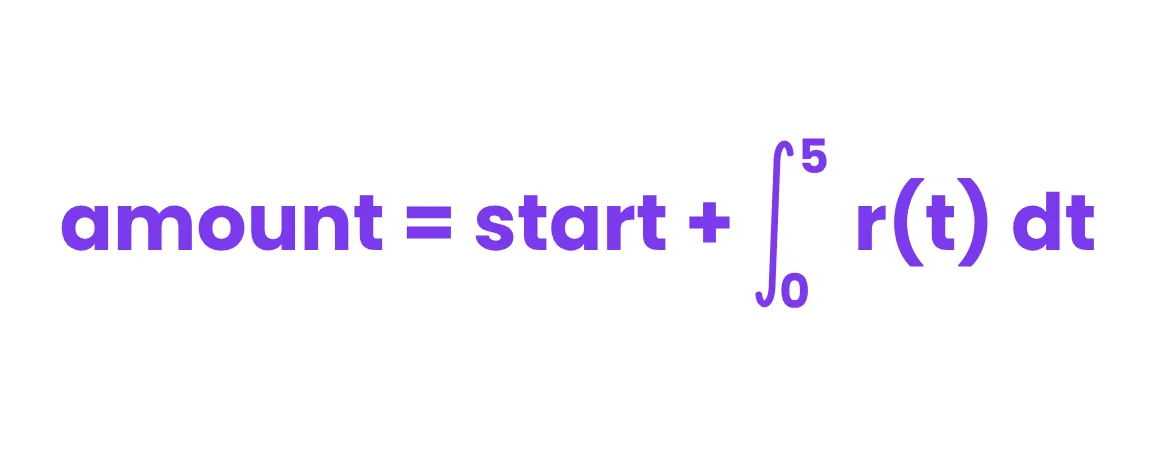
If water flows in at a rate r of t, the integral of r from 0 to 5 is how much water came in.
The amount at the end is the starting amount plus that integral.
amount = start + ∫₀⁵ r(t) dt
2. Riemann sums and trapezoids
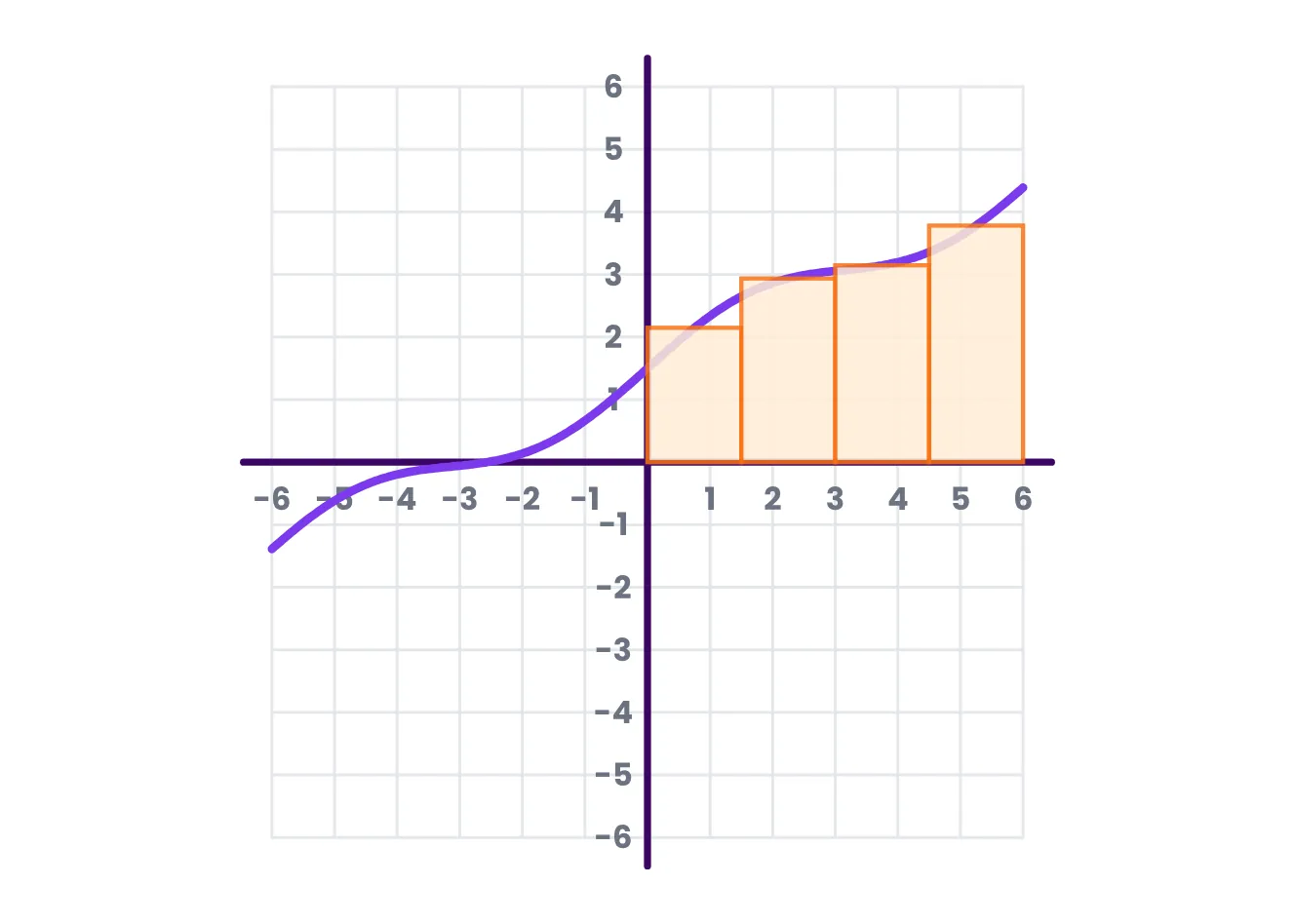
From a table, estimate the integral with rectangles or trapezoids.
3. Average value
The average value of f on an interval is the integral divided by the length of the interval.
f_avg = (1/(b − a)) ∫ₐᵇ f dx

Watch out: Include the start
The integral gives the change. Add the starting amount for the total.
Wrong: answer = 12. Right: answer = 20 + 12.
Your turn
A tank has 20 liters. Water flows in, and the integral of the rate from 0 to 4 is 12. How much is in the tank at time 4?
start 20, ∫ = 12
Answer: 32 L. 20 plus 12 is 32 liters!
Remember
Integrals accumulate rates. Start plus change gives the amount.
start + ∫ rate
Watch the Integrals lesson and practice · Printable worksheet