Quadratic Formula notes (ACT Math)
Use the quadratic formula to solve equations.
The big question
x = (−b ± √(b² − 4ac)) / 2a
Is there a formula that solves every quadratic? Yes!
Learn it, step by step
1. Find a, b, c
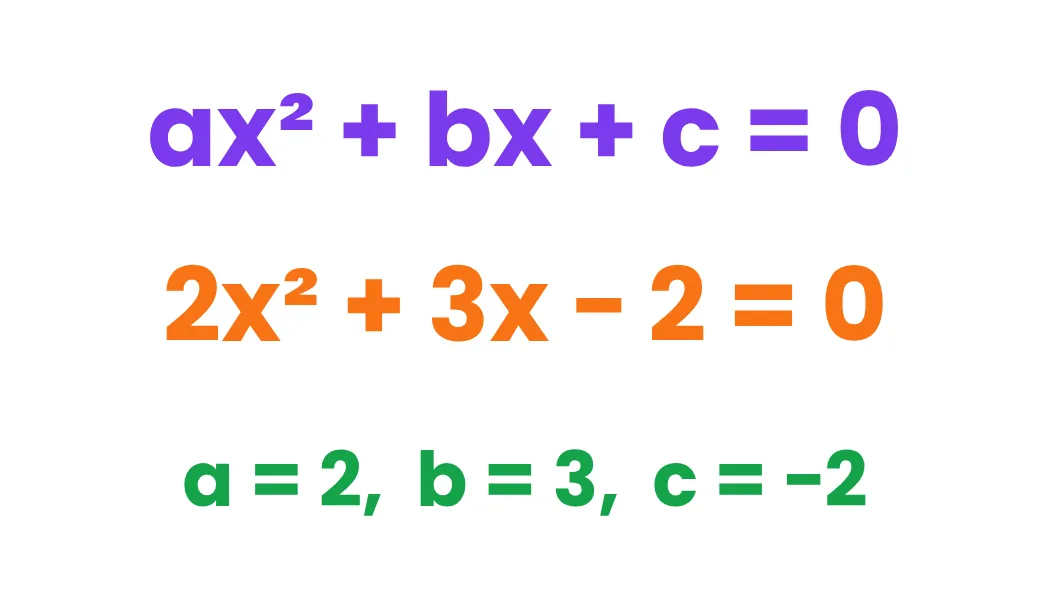
Write the equation as ax² + bx + c = 0.
In 2x² + 3x − 2 = 0: a = 2, b = 3, c = −2.
ax² + bx + c = 0
2x² + 3x − 2 = 0
a = 2, b = 3, c = −2
2. The formula
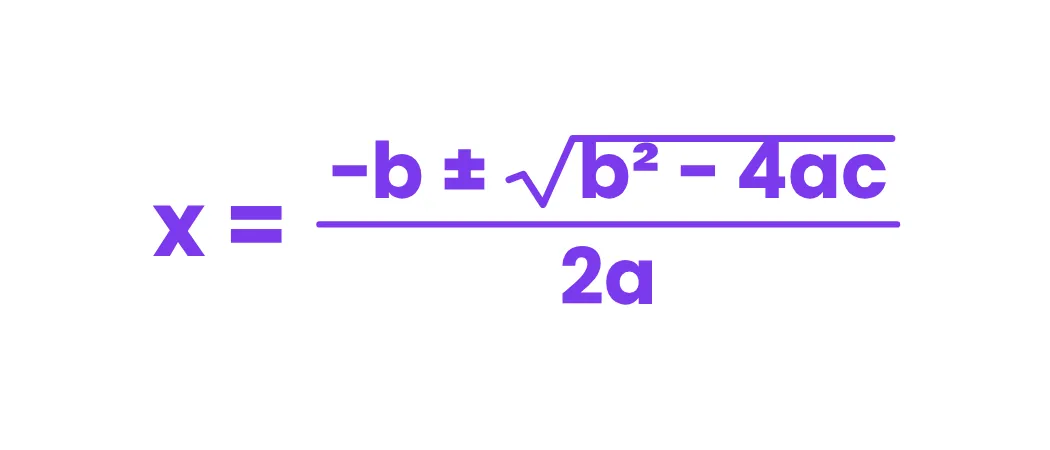
x = negative b, plus or minus the square root of b² − 4ac, all over 2a.
x = (−b ± √(b² − 4ac)) / 2a
3. Plug in
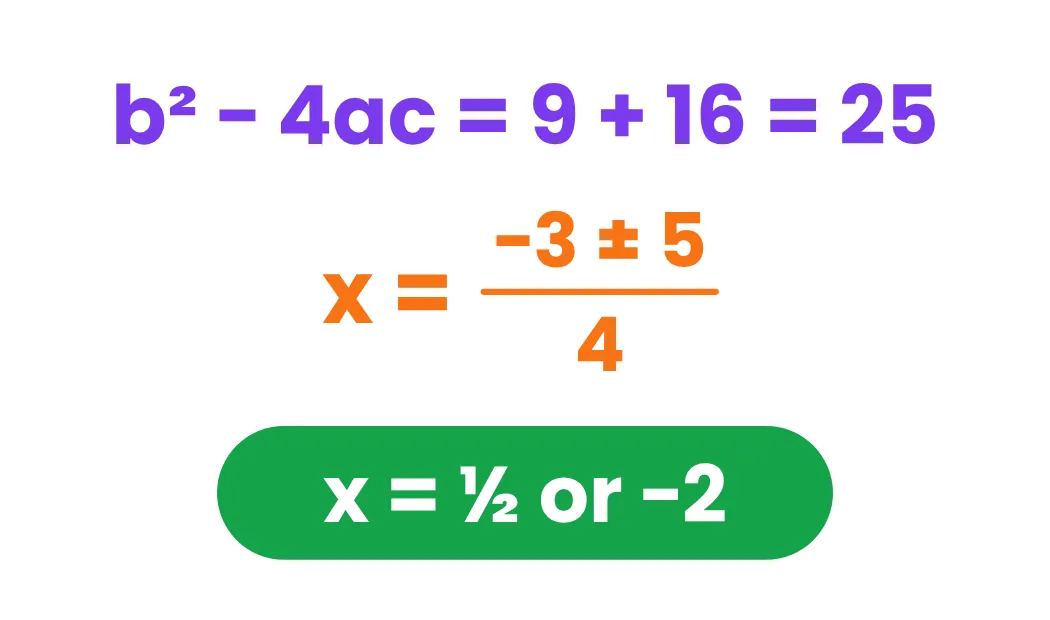
b² − 4ac = 9 − 4(2)(−2) = 9 + 16 = 25. Its square root is 5.
x = (−3 ± 5) ÷ 4. So x = ½ or x = −2.
b² − 4ac = 9 + 16 = 25
x = (−3 ± 5) / 4
x = ½ or −2
4. The discriminant
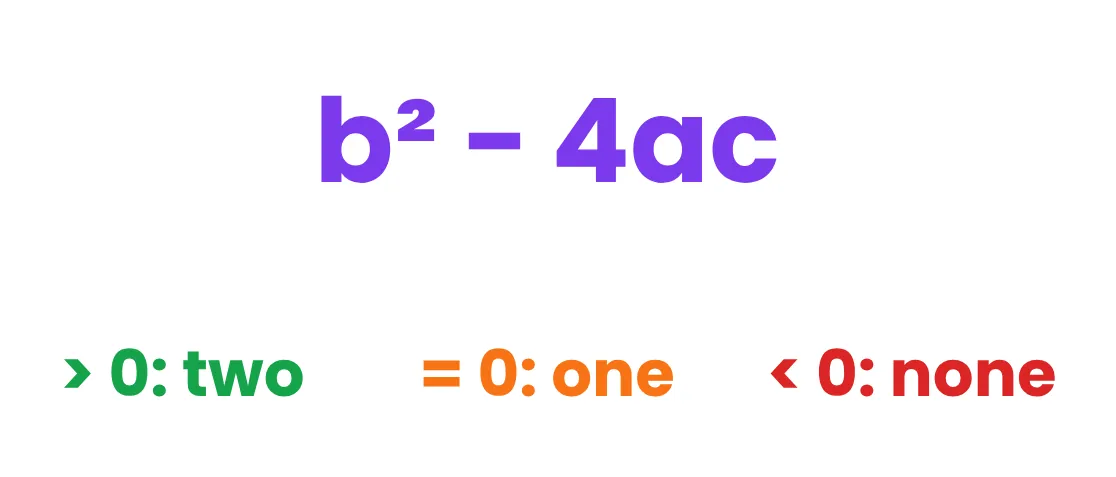
b² − 4ac tells how many real solutions there are.
Positive: two. Zero: one. Negative: none.
b² − 4ac
> 0: two
= 0: one
< 0: none
Watch out: Watch the signs
If b is −4, then −b is +4, and b² is +16.
Wrong: b = −4: −b = −4. Right: b = −4: −b = 4, b² = 16.
Your turn
For x² − 4x + 4 = 0, what is the discriminant?
x² − 4x + 4 = 0
Answer: 0 → one solution. 16 − 16 = 0. One solution: x = 2!
Remember
Write it in standard form, find a, b and c, and plug into the formula.
The discriminant counts the solutions.
x = (−b ± √(b² − 4ac)) / 2a
Watch the Quadratic Formula lesson and practice · Printable worksheet