Angle Relationships notes (ACT Math)
Complementary, supplementary, vertical, and adjacent angles.
The big question
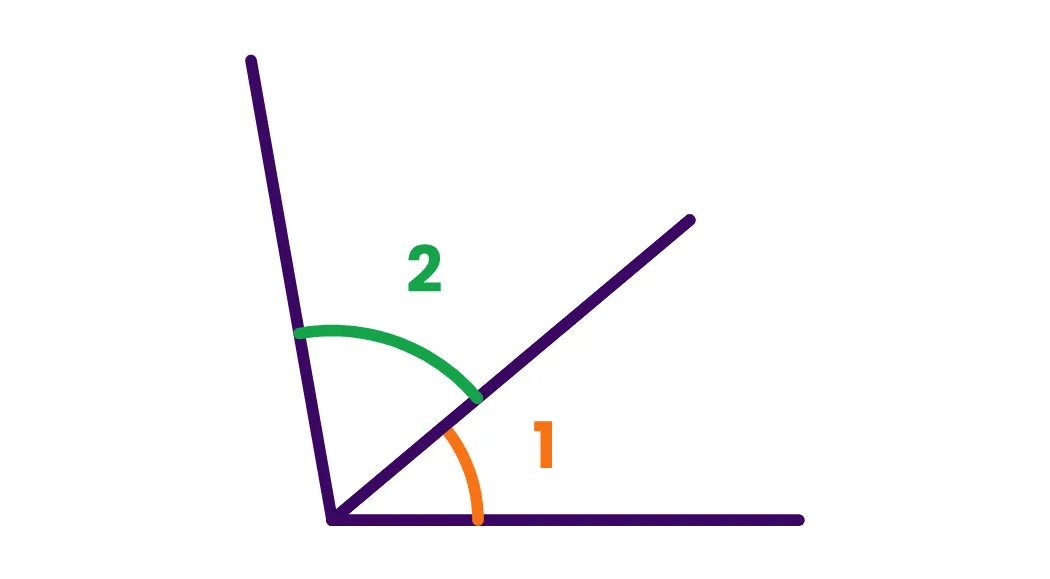
∠1 ∠2
How are angles that share a side related? Let's name the pairs!
Learn it, step by step
1. Adjacent angles
Adjacent angles share a vertex and a side, without overlapping.
2. Linear pair
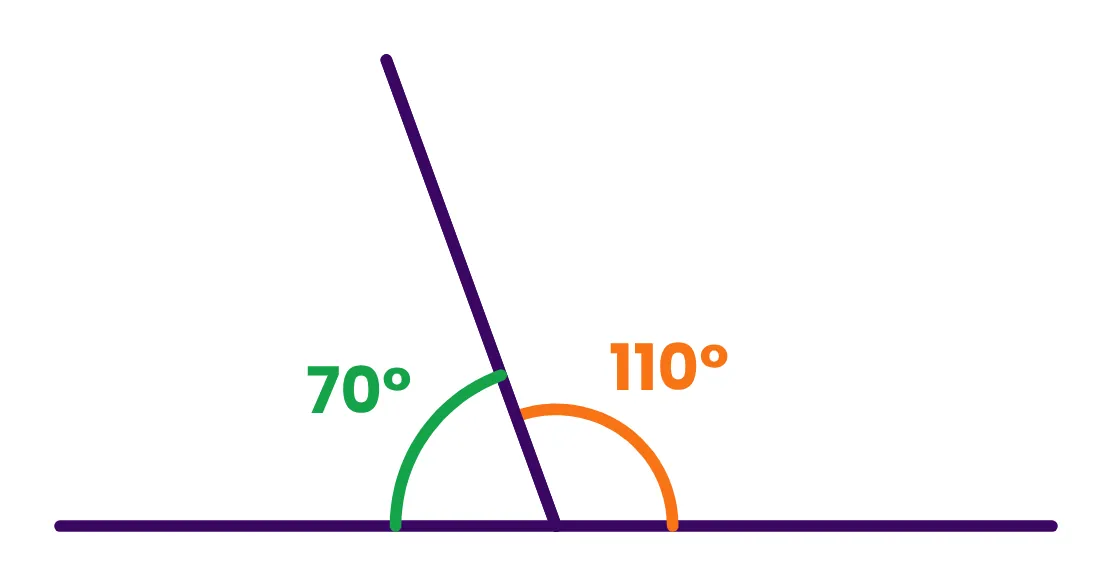
Two adjacent angles that form a straight line are a linear pair. They add to 180.
If one is 110, the other is 70.
110°
70°
3. Vertical angles
Lines crossing make two pairs of vertical angles. Vertical angles are equal.
Why? Each pairs with the same neighbor to make 180.

4. Solve with algebra
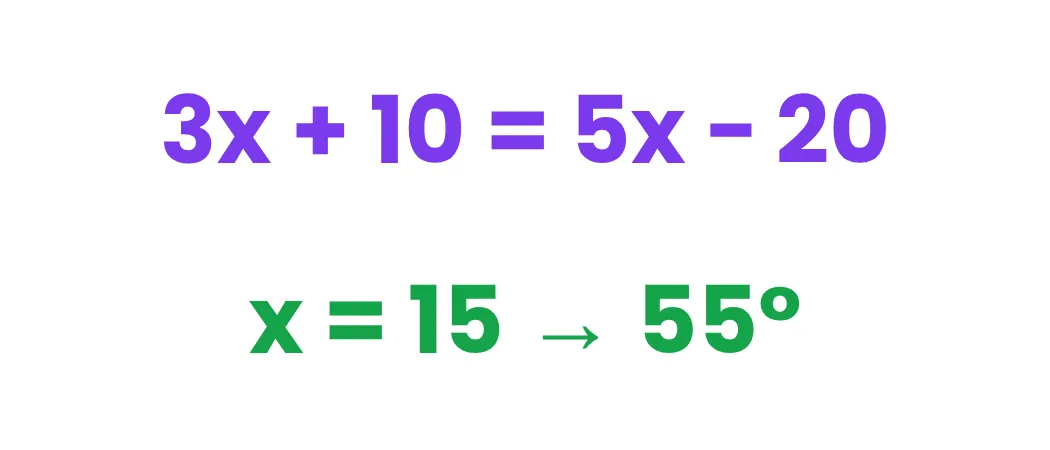
Vertical angles 3x + 10 and 5x − 20 are equal.
3x + 10 = 5x − 20, so 30 = 2x, x = 15. Each angle is 55.
3x + 10 = 5x − 20
x = 15 → 55°
Watch out: Linear pair vs vertical
A linear pair adds to 180. Vertical angles are equal. Don't mix them up.
Wrong: vertical angles add to 180. Right: vertical angles are equal.
Your turn
Two angles form a linear pair. One is 4x and the other is 2x. Find x.
4x + 2x = ?
Answer: x = 30. 6x = 180, so x = 30!
Remember
Linear pair: 180. Vertical angles: equal. Complementary: 90.
180 · equal · 90
Watch the Angle Relationships lesson and practice · Printable worksheet